find all relative maxima and minima of the following function. f(x)=4x^3 - 3x^2 - 60x + 17 f(x) has a…
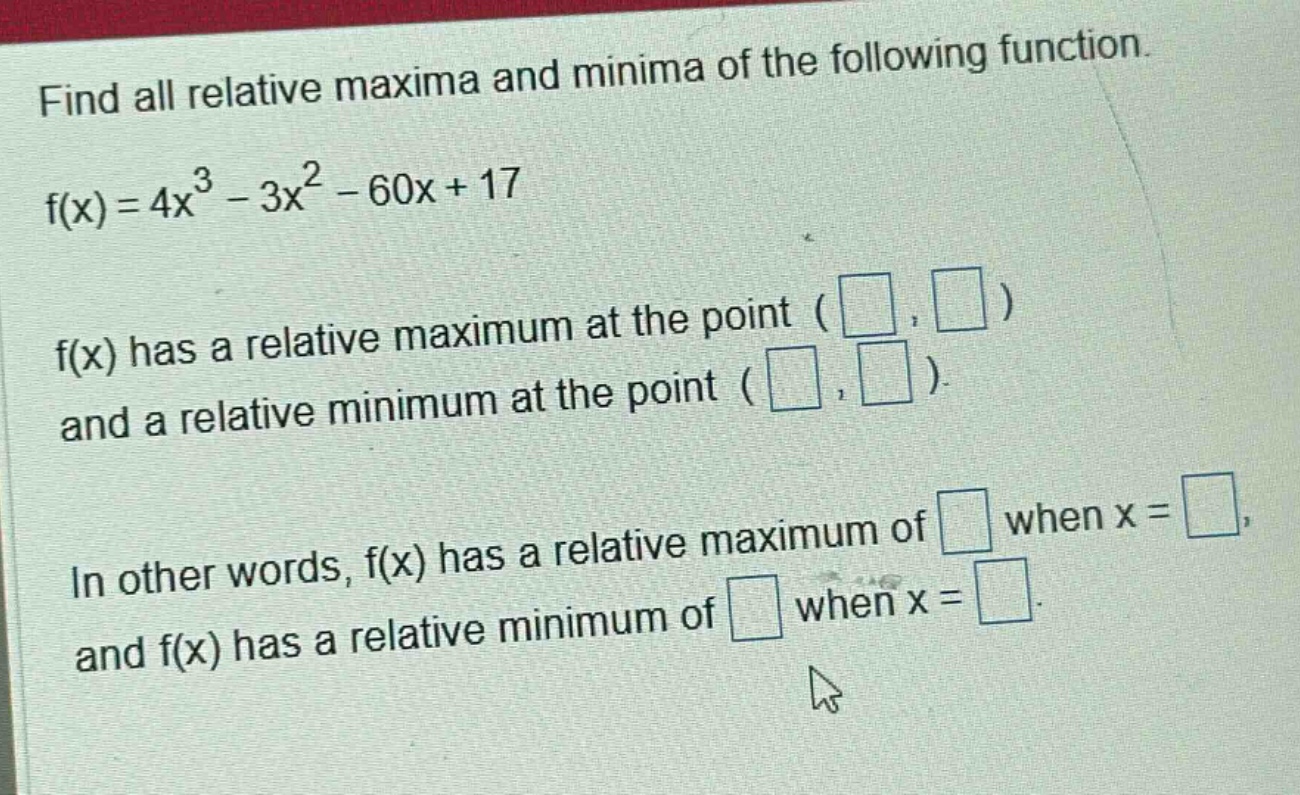
find all relative maxima and minima of the following function. f(x)=4x^3 - 3x^2 - 60x + 17 f(x) has a relative maximum at the point ( , ) and a relative minimum at the point ( , ). in other words, f(x) has a relative maximum of when x = , and f(x) has a relative minimum of when x = .
Answer
Explanation:
Step1: Find the derivative
Differentiate $f(x)=4x^{3}-3x^{2}-60x + 17$ using the power - rule. $f'(x)=12x^{2}-6x - 60$.
Step2: Set the derivative equal to zero
$12x^{2}-6x - 60 = 0$. Divide through by 6: $2x^{2}-x - 10=0$.
Step3: Solve the quadratic equation
Use the quadratic formula $x=\frac{-b\pm\sqrt{b^{2}-4ac}}{2a}$ for $ax^{2}+bx + c = 0$. Here $a = 2$, $b=-1$, $c=-10$. So $x=\frac{1\pm\sqrt{(-1)^{2}-4\times2\times(-10)}}{2\times2}=\frac{1\pm\sqrt{1 + 80}}{4}=\frac{1\pm9}{4}$. The solutions are $x=\frac{1 + 9}{4}=\frac{5}{2}$ and $x=\frac{1-9}{4}=-2$.
Step4: Find the second - derivative
Differentiate $f'(x)=12x^{2}-6x - 60$ to get $f''(x)=24x-6$.
Step5: Use the second - derivative test
For $x=-2$, $f''(-2)=24\times(-2)-6=-48 - 6=-54<0$. So $f(x)$ has a relative maximum at $x = - 2$. $f(-2)=4\times(-2)^{3}-3\times(-2)^{2}-60\times(-2)+17=-32-12 + 120+17=93$. For $x=\frac{5}{2}$, $f''(\frac{5}{2})=24\times\frac{5}{2}-6=60 - 6 = 54>0$. So $f(x)$ has a relative minimum at $x=\frac{5}{2}$. $f(\frac{5}{2})=4\times(\frac{5}{2})^{3}-3\times(\frac{5}{2})^{2}-60\times\frac{5}{2}+17=4\times\frac{125}{8}-3\times\frac{25}{4}-150 + 17=\frac{125}{2}-\frac{75}{4}-150 + 17=\frac{250 - 75}{4}-150 + 17=\frac{175}{4}-150 + 17=\frac{175-600 + 68}{4}=-\frac{357}{4}$.
Answer:
$f(x)$ has a relative maximum at the point $(-2,93)$ and a relative minimum at the point $(\frac{5}{2},-\frac{357}{4})$. In other words, $f(x)$ has a relative maximum of $93$ when $x=-2$, and $f(x)$ has a relative minimum of $-\frac{357}{4}$ when $x = \frac{5}{2}$.