5. find sin(2α) exactly if sin α = 1/4 and π/2 < α < π. a. √15/8 b. -√15/8 c. √17/8 d. -√17/8 e. none of the…
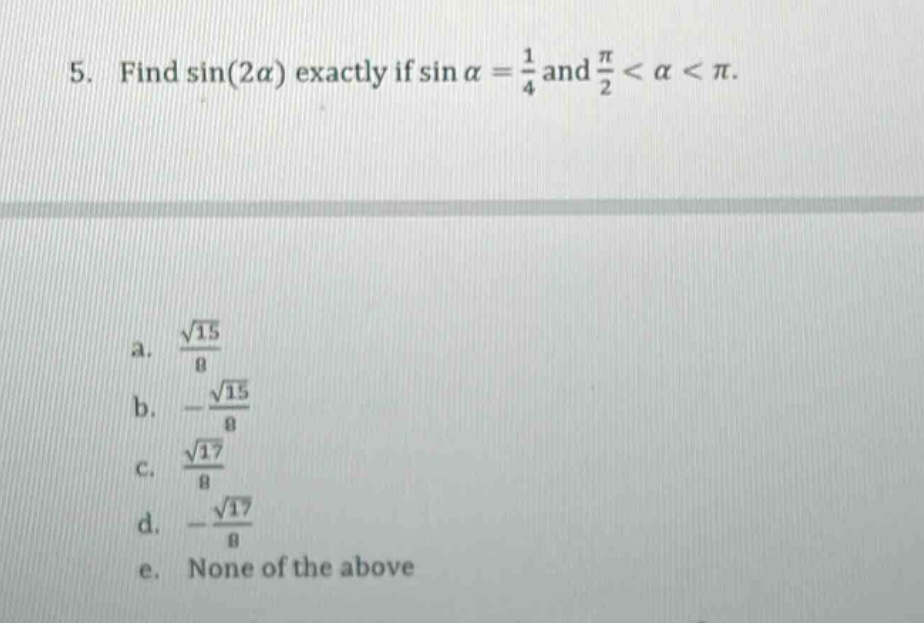
5. find sin(2α) exactly if sin α = 1/4 and π/2 < α < π. a. √15/8 b. -√15/8 c. √17/8 d. -√17/8 e. none of the above
Answer
Explanation:
Step1: Find cos(α)
We know that $\sin^{2}\alpha+\cos^{2}\alpha = 1$. Given $\sin\alpha=\frac{1}{4}$, then $\cos^{2}\alpha=1 - \sin^{2}\alpha=1-\left(\frac{1}{4}\right)^{2}=1-\frac{1}{16}=\frac{15}{16}$, so $\cos\alpha=\pm\frac{\sqrt{15}}{4}$. Since $\frac{\pi}{2}<\alpha<\pi$ (second - quadrant where cosine is negative), $\cos\alpha=-\frac{\sqrt{15}}{4}$.
Step2: Use double - angle formula for sine
The double - angle formula for sine is $\sin(2\alpha)=2\sin\alpha\cos\alpha$. Substitute $\sin\alpha = \frac{1}{4}$ and $\cos\alpha=-\frac{\sqrt{15}}{4}$ into the formula. Then $\sin(2\alpha)=2\times\frac{1}{4}\times\left(-\frac{\sqrt{15}}{4}\right)=-\frac{\sqrt{15}}{8}$.
Answer:
B. $-\frac{\sqrt{15}}{8}$