find all solutions of the equation in the interval 0, 2π). sinx + 1 = cosx write your answer(s) in radians…
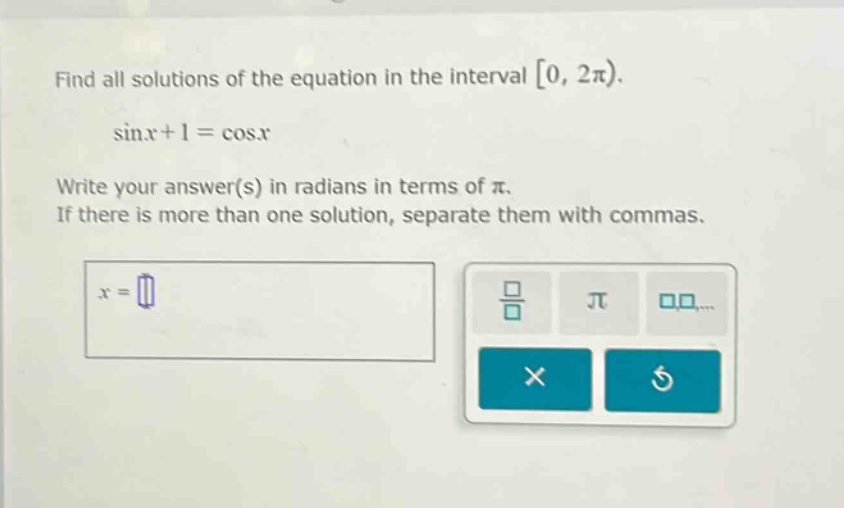
find all solutions of the equation in the interval 0, 2π). sinx + 1 = cosx write your answer(s) in radians in terms of π. if there is more than one solution, separate them with commas. x =
Answer
Explanation:
Step1: Square both sides
$(\sin x + 1)^2=\cos^{2}x$. Expanding gives $\sin^{2}x + 2\sin x+1=\cos^{2}x$.
Step2: Use trig identity
Since $\cos^{2}x = 1-\sin^{2}x$, substitute it into the equation: $\sin^{2}x + 2\sin x+1=1-\sin^{2}x$.
Step3: Rearrange the equation
Move all terms to one - side: $\sin^{2}x+\sin^{2}x + 2\sin x+1 - 1=0$, which simplifies to $2\sin^{2}x+2\sin x = 0$.
Step4: Factor out common factor
Factor out $2\sin x$: $2\sin x(\sin x + 1)=0$.
Step5: Solve for $\sin x$
Set each factor equal to zero:
- If $2\sin x=0$, then $\sin x = 0$. In the interval $[0,2\pi)$, $x = 0,\pi$.
- If $\sin x+1 = 0$, then $\sin x=-1$. In the interval $[0,2\pi)$, $x=\frac{3\pi}{2}$.
Step6: Check for extraneous solutions
Substitute the solutions back into the original equation $\sin x + 1=\cos x$:
- For $x = 0$: $\sin(0)+1=1$ and $\cos(0)=1$, so $x = 0$ is a solution.
- For $x=\pi$: $\sin(\pi)+1 = 1$ and $\cos(\pi)=-1$, so $x=\pi$ is not a solution.
- For $x=\frac{3\pi}{2}$: $\sin(\frac{3\pi}{2})+1=0$ and $\cos(\frac{3\pi}{2})=0$, so $x=\frac{3\pi}{2}$ is a solution.
Answer:
$0,\frac{3\pi}{2}$