(c) find the sum of each of the following series.\n(i) ∑(n = 2 to ∞) n(n - 1)x^n, |x| < 1\n2x^2 / (1…
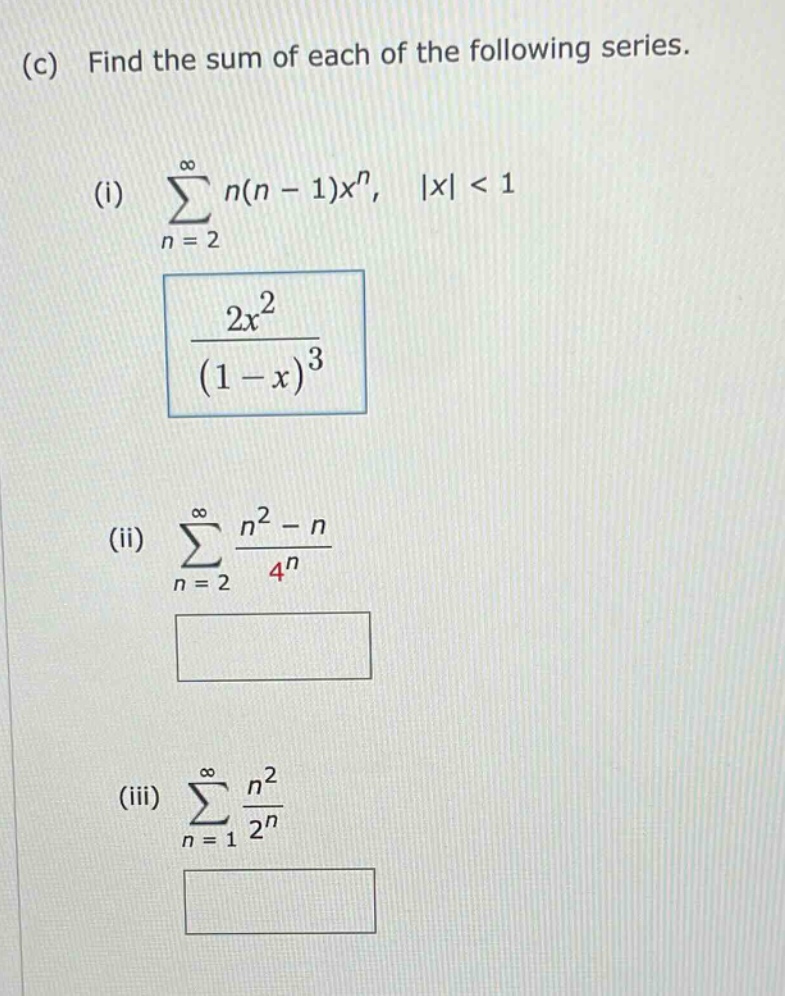
(c) find the sum of each of the following series.\n(i) ∑(n = 2 to ∞) n(n - 1)x^n, |x| < 1\n2x^2 / (1 - x)^3\n(ii) ∑(n = 2 to ∞) (n^2 - n) / 4^n\n(iii) ∑(n = 1 to ∞) n^2 / 2^n
Answer
Explanation:
Step1: Recall geometric - series formula
The geometric series $\sum_{n = 0}^{\infty}x^{n}=\frac{1}{1 - x}$, for $|x|\lt1$.
Step2: Differentiate twice
Differentiate $\sum_{n = 0}^{\infty}x^{n}=\frac{1}{1 - x}$ with respect to $x$ once: $\sum_{n = 1}^{\infty}nx^{n - 1}=\frac{1}{(1 - x)^{2}}$. Differentiate again: $\sum_{n = 2}^{\infty}n(n - 1)x^{n - 2}=\frac{2}{(1 - x)^{3}}$. Then $\sum_{n = 2}^{\infty}n(n - 1)x^{n}=\frac{2x^{2}}{(1 - x)^{3}}$.
Step3: Solve (ii)
Let $x=\frac{1}{4}$ in $\sum_{n = 2}^{\infty}n(n - 1)x^{n}=\frac{2x^{2}}{(1 - x)^{3}}$. Substituting $x = \frac{1}{4}$ gives $\sum_{n = 2}^{\infty}\frac{n^{2}-n}{4^{n}}=\frac{2\times(\frac{1}{4})^{2}}{(1-\frac{1}{4})^{3}}=\frac{2\times\frac{1}{16}}{(\frac{3}{4})^{3}}=\frac{\frac{1}{8}}{\frac{27}{64}}=\frac{8}{27}$.
Step4: Rewrite $n^{2}$
We know that $n^{2}=n(n - 1)+n$. So $\sum_{n = 1}^{\infty}\frac{n^{2}}{2^{n}}=\sum_{n = 1}^{\infty}\frac{n(n - 1)}{2^{n}}+\sum_{n = 1}^{\infty}\frac{n}{2^{n}}$. For $\sum_{n = 2}^{\infty}n(n - 1)x^{n}=\frac{2x^{2}}{(1 - x)^{3}}$, when $x=\frac{1}{2}$, $\sum_{n = 2}^{\infty}\frac{n(n - 1)}{2^{n}}=\frac{2\times(\frac{1}{2})^{2}}{(1-\frac{1}{2})^{3}} = 4$. For $\sum_{n = 1}^{\infty}nx^{n - 1}=\frac{1}{(1 - x)^{2}}$, then $\sum_{n = 1}^{\infty}nx^{n}=\frac{x}{(1 - x)^{2}}$. When $x=\frac{1}{2}$, $\sum_{n = 1}^{\infty}\frac{n}{2^{n}}=\frac{\frac{1}{2}}{(1-\frac{1}{2})^{2}}=2$. So $\sum_{n = 1}^{\infty}\frac{n^{2}}{2^{n}}=4 + 2=6$.
Answer:
(i) $\frac{2x^{2}}{(1 - x)^{3}}$ (ii) $\frac{8}{27}$ (iii) $6$