(a) find the sum of the series ∑(n = 1 to ∞) nx^(n - 1), |x| < 1. (b) find the sum of each of the following…
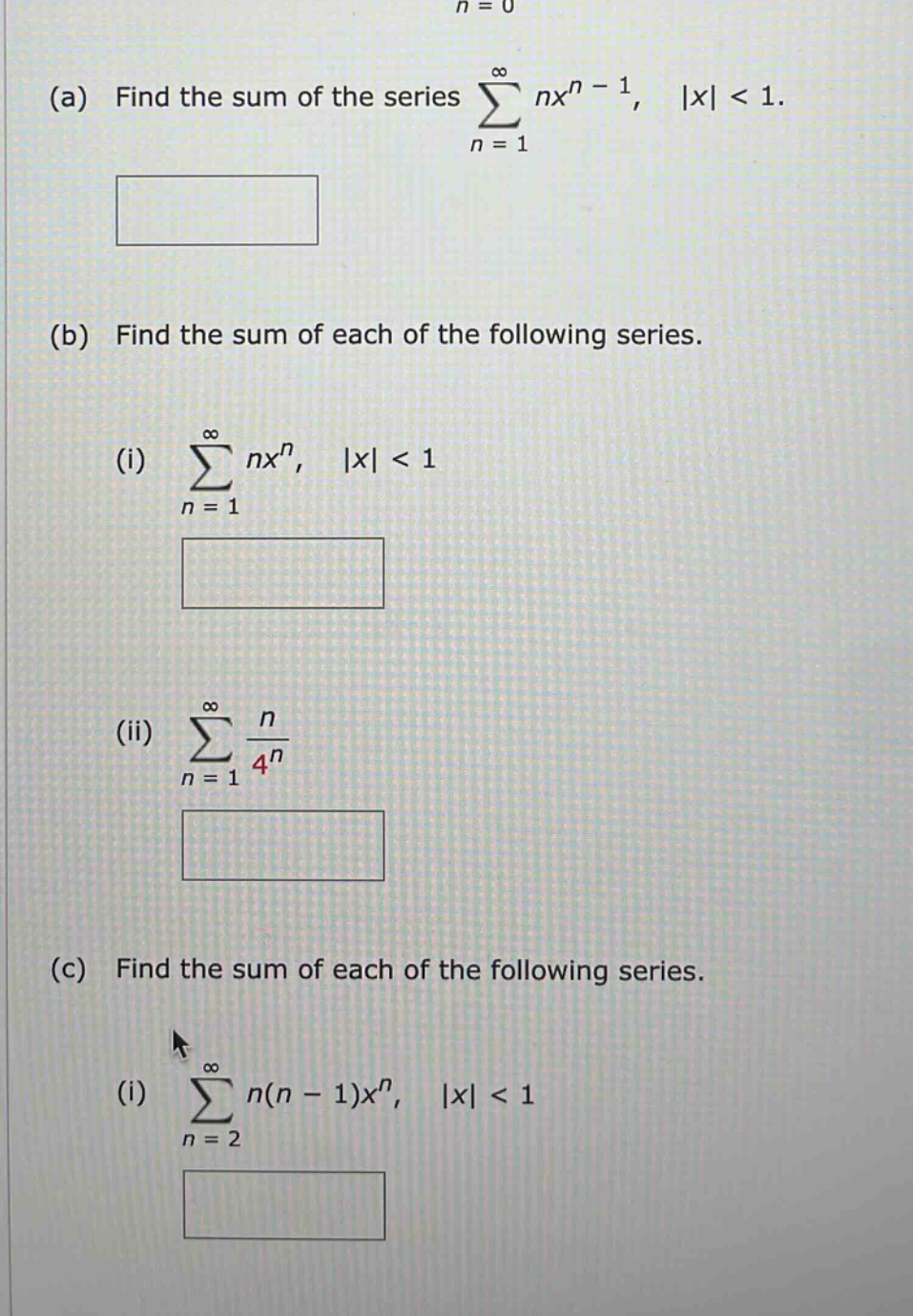
(a) find the sum of the series ∑(n = 1 to ∞) nx^(n - 1), |x| < 1. (b) find the sum of each of the following series. (i) ∑(n = 1 to ∞) nx^n, |x| < 1 (ii) ∑(n = 1 to ∞) n/4^n (c) find the sum of each of the following series. (i) ∑(n = 2 to ∞) n(n - 1)x^n, |x| < 1
Answer
Explanation:
Step1: Recall geometric - series formula
The geometric series $\sum_{n = 0}^{\infty}x^{n}=\frac{1}{1 - x}$, for $|x|\lt1$. Differentiate both sides with respect to $x$. The derivative of $\sum_{n = 0}^{\infty}x^{n}$ is $\sum_{n = 1}^{\infty}nx^{n - 1}$, and the derivative of $\frac{1}{1 - x}=(1 - x)^{-1}$ using the power - rule $(u^{-1})^\prime=-u^{-2}u^\prime$. So, $\frac{d}{dx}\frac{1}{1 - x}=\frac{1}{(1 - x)^{2}}$. Thus, $\sum_{n = 1}^{\infty}nx^{n - 1}=\frac{1}{(1 - x)^{2}}$, for $|x|\lt1$.
Step2: Find the sum of $\sum_{n = 1}^{\infty}nx^{n}$
We know that $\sum_{n = 1}^{\infty}nx^{n}=x\sum_{n = 1}^{\infty}nx^{n - 1}$. Since $\sum_{n = 1}^{\infty}nx^{n - 1}=\frac{1}{(1 - x)^{2}}$, then $\sum_{n = 1}^{\infty}nx^{n}=\frac{x}{(1 - x)^{2}}$, for $|x|\lt1$.
Step3: Find the sum of $\sum_{n = 1}^{\infty}\frac{n}{4^{n}}$
Let $x=\frac{1}{4}$ in the formula $\sum_{n = 1}^{\infty}nx^{n}=\frac{x}{(1 - x)^{2}}$. Then $\sum_{n = 1}^{\infty}\frac{n}{4^{n}}=\frac{\frac{1}{4}}{(1-\frac{1}{4})^{2}}=\frac{\frac{1}{4}}{\frac{9}{16}}=\frac{4}{9}$.
Step4: Differentiate $\sum_{n = 1}^{\infty}nx^{n - 1}$ again
We know that $\sum_{n = 1}^{\infty}nx^{n - 1}=\frac{1}{(1 - x)^{2}}$. Differentiate both sides with respect to $x$. The derivative of $\sum_{n = 1}^{\infty}nx^{n - 1}$ is $\sum_{n = 2}^{\infty}n(n - 1)x^{n - 2}$, and the derivative of $\frac{1}{(1 - x)^{2}}=(1 - x)^{-2}$. Using the power - rule $(u^{-2})^\prime = 2u^{-3}u^\prime$, we get $\frac{d}{dx}\frac{1}{(1 - x)^{2}}=\frac{2}{(1 - x)^{3}}$. So, $\sum_{n = 2}^{\infty}n(n - 1)x^{n - 2}=\frac{2}{(1 - x)^{3}}$. Multiply both sides by $x^{2}$ to get $\sum_{n = 2}^{\infty}n(n - 1)x^{n}=\frac{2x^{2}}{(1 - x)^{3}}$, for $|x|\lt1$.
Answer:
(a) $\frac{1}{(1 - x)^{2}}$ (b)(i) $\frac{x}{(1 - x)^{2}}$ (b)(ii) $\frac{4}{9}$ (c)(i) $\frac{2x^{2}}{(1 - x)^{3}}$