find the taylor series for f(x) centered at the given value of a. assume that f has a power series…
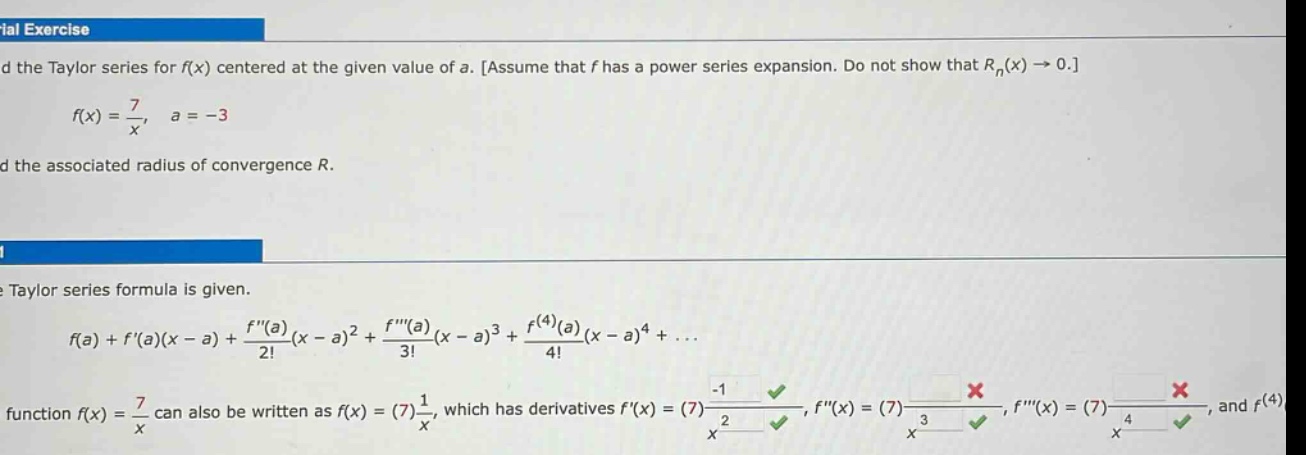
find the taylor series for f(x) centered at the given value of a. assume that f has a power series expansion. do not show that r_n(x) -> 0. f(x) = 7/x, a = -3 find the associated radius of convergence r. the taylor series formula is given. f(a)+f(a)(x - a)+f(a)/2!(x - a)^2 + f(a)/3!(x - a)^3 + f^(4)(a)/4!(x - a)^4+... the function f(x) = 7/x can also be written as f(x)=(7)1/x, which has derivatives f(x)=(7)-1/x^2, f(x)=(7)_, f(x)=(7)_, and f^(4)
Answer
Explanation:
Step1: Find the (n) -th derivative of (f(x))
The (n) -th derivative of (f(x)=\frac{7}{x}=7x^{- 1}) is (f^{(n)}(x)=7(-1)(-2)\cdots(-n)x^{-(n + 1)}=\frac{7(-1)^{n}n!}{x^{n+1}}).
Step2: Evaluate (f^{(n)}(a)) at (a=-3)
Substitute (x = a=-3) into (f^{(n)}(x)), we get (f^{(n)}(-3)=\frac{7(-1)^{n}n!}{(-3)^{n + 1}}).
Step3: Write the Taylor - series
Using the Taylor - series formula (f(x)=\sum_{n = 0}^{\infty}\frac{f^{(n)}(a)}{n!}(x - a)^{n}), with (a=-3), we have: [ \begin{align*} f(x)&=\sum_{n = 0}^{\infty}\frac{\frac{7(-1)^{n}n!}{(-3)^{n+1}}}{n!}(x + 3)^{n}\ &=\sum_{n = 0}^{\infty}\frac{7(-1)^{n}}{(-3)^{n+1}}(x + 3)^{n}\ &=\sum_{n = 0}^{\infty}\frac{7(-1)^{n}}{(-1)^{n+1}3^{n+1}}(x + 3)^{n}\ &=\sum_{n = 0}^{\infty}-\frac{7}{3^{n + 1}}(x + 3)^{n} \end{align*} ]
Step4: Find the radius of convergence (R)
Use the ratio - test. Let (u_{n}=-\frac{7}{3^{n + 1}}(x + 3)^{n}), then (u_{n+1}=-\frac{7}{3^{n+2}}(x + 3)^{n+1}). [ \begin{align*} \lim_{n\rightarrow\infty}\left|\frac{u_{n + 1}}{u_{n}}\right|&=\lim_{n\rightarrow\infty}\left|\frac{-\frac{7}{3^{n+2}}(x + 3)^{n+1}}{-\frac{7}{3^{n+1}}(x + 3)^{n}}\right|\ &=\lim_{n\rightarrow\infty}\left|\frac{x + 3}{3}\right|=\left|\frac{x + 3}{3}\right| \end{align*} ] For convergence, (\left|\frac{x + 3}{3}\right|\lt1), which implies (|x+3|\lt3). So the radius of convergence (R = 3).
Answer:
The Taylor series of (f(x)=\frac{7}{x}) centered at (a=-3) is (\sum_{n = 0}^{\infty}-\frac{7}{3^{n + 1}}(x + 3)^{n}), and the radius of convergence (R = 3).