find the time t at which the particle is farthest to the right. a particle moves along the x - axis with…
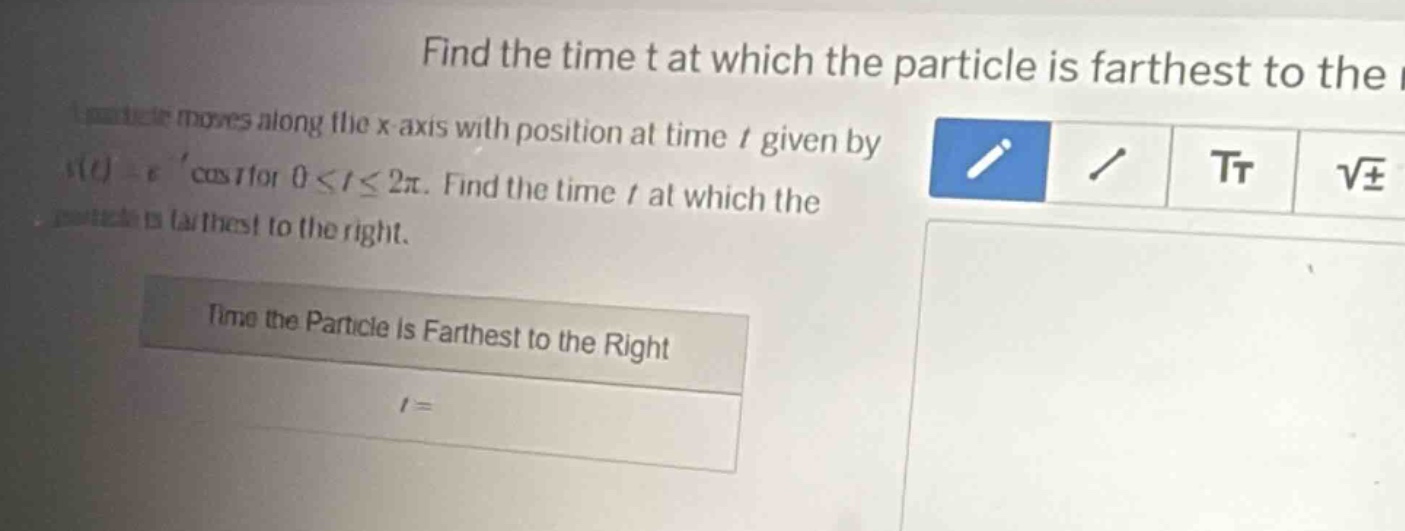
find the time t at which the particle is farthest to the right. a particle moves along the x - axis with position at time t given by s(t)=e^t cos t for 0≤t≤2π. find the time t at which the particle is farthest to the right. time the particle is farthest to the right t=
Answer
Explanation:
Step1: Find the velocity function
The velocity $v(t)$ is the derivative of the position function $s(t)$. Given $s(t)=e^{t}\cos t$, using the product - rule $(uv)^\prime = u^\prime v+uv^\prime$ where $u = e^{t}$ and $v=\cos t$. So $v(t)=e^{t}\cos t - e^{t}\sin t=e^{t}(\cos t-\sin t)$.
Step2: Find the critical points
Set $v(t) = 0$. Since $e^{t}>0$ for all real $t$, we solve $\cos t-\sin t = 0$. Then $\cos t=\sin t$, so $\tan t = 1$. In the interval $0\leq t\leq2\pi$, $t=\frac{\pi}{4},\frac{5\pi}{4}$.
Step3: Determine the maximum
We can use the second - derivative test or evaluate the position function at the critical points and endpoints. First, find the second - derivative $s^{\prime\prime}(t)=e^{t}(\cos t-\sin t)+e^{t}(-\sin t - \cos t)=-2e^{t}\sin t$. Evaluate $s(t)$ at $t = 0$, $s(0)=e^{0}\cos(0)=1$; at $t=\frac{\pi}{4}$, $s(\frac{\pi}{4})=e^{\frac{\pi}{4}}\cos(\frac{\pi}{4})=\frac{e^{\frac{\pi}{4}}}{\sqrt{2}}$; at $t=\frac{5\pi}{4}$, $s(\frac{5\pi}{4})=e^{\frac{5\pi}{4}}\cos(\frac{5\pi}{4})=-\frac{e^{\frac{5\pi}{4}}}{\sqrt{2}}$; at $t = 2\pi$, $s(2\pi)=e^{2\pi}\cos(2\pi)=e^{2\pi}$. Since we want the right - most position, comparing the values, we find that the maximum occurs at $t=\frac{\pi}{4}$.
Answer:
$t=\frac{\pi}{4}$