find the total area of the shaded regions enclosed by y = x^3 - x^2 - 14x and y = -x^2 + 2x.
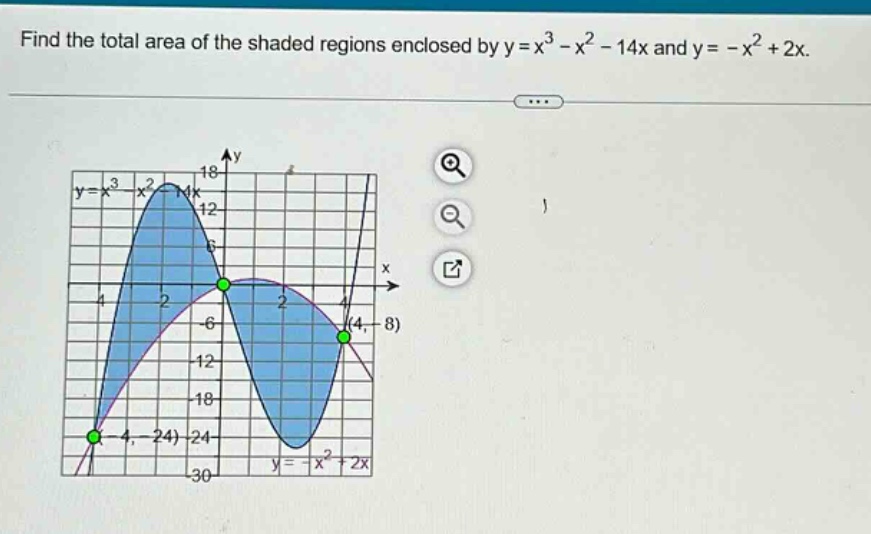
find the total area of the shaded regions enclosed by y = x^3 - x^2 - 14x and y = -x^2 + 2x.
Answer
Explanation:
Step 1: Find intersection points
Set ( x^3 - x^2 - 14x = -x^2 + 2x ):
( x^3 - 16x = 0 )
( x(x^2 - 16) = 0 )
Solutions: ( x = -4, 0, 4 ).
Step 2: Determine upper/lower functions in intervals
- For ( x \in [-4, 0] ): ( y_1 = x^3 - x^2 - 14x ) is above ( y_2 = -x^2 + 2x ).
Difference: ( (x^3 - x^2 - 14x) - (-x^2 + 2x) = x^3 - 16x ). - For ( x \in [0, 4] ): ( y_2 ) is above ( y_1 ).
Difference: ( (-x^2 + 2x) - (x^3 - x^2 - 14x) = -x^3 + 16x ).
Step 3: Integrate over intervals
First integral (( [-4, 0] )):
[
\int_{-4}^{0} (x^3 - 16x) , dx = \left[ \frac{x^4}{4} - 8x^2 \right]_{-4}^{0} = 0 - \left( \frac{(-4)^4}{4} - 8(-4)^2 \right) = - (64 - 128) = 64
]
Second integral (( [0, 4] )):
[
\int_{0}^{4} (-x^3 + 16x) , dx = \left[ -\frac{x^4}{4} + 8x^2 \right]_{0}^{4} = \left( -\frac{256}{4} + 128 \right) - 0 = (-64 + 128) = 64
]
Step 4: Sum areas
Total area: ( 64 + 64 = 128 ).
Answer:
128