find the transformations required to obtain the graph starting with a basic trig function. 9) y = 5cos(θ +…
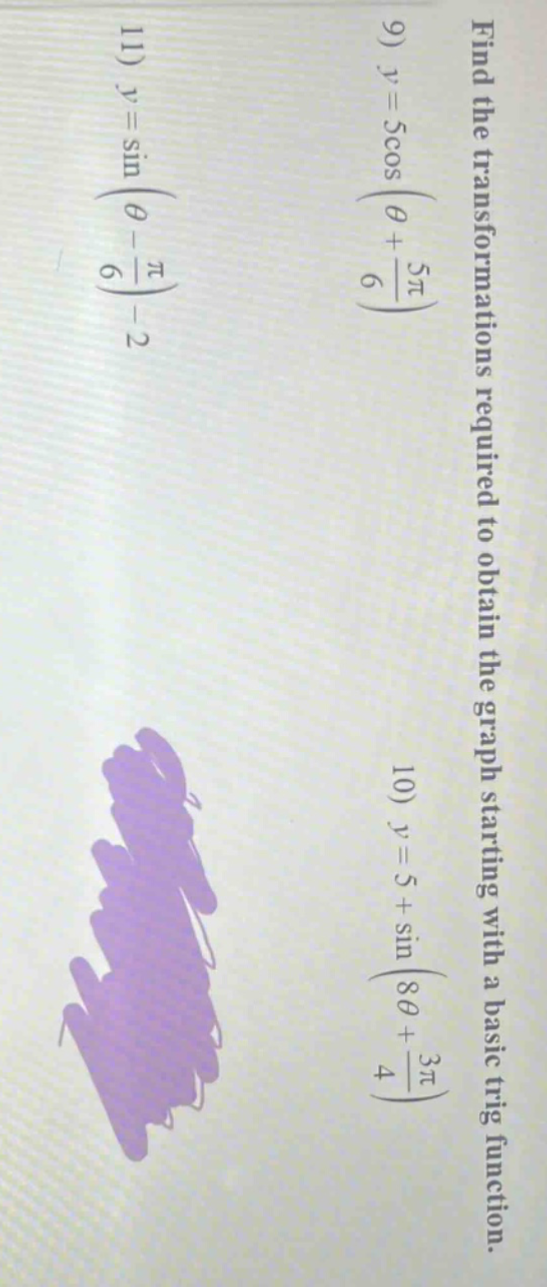
find the transformations required to obtain the graph starting with a basic trig function. 9) y = 5cos(θ + 5π/6) 10) y = 5 + sin(8θ + 3π/4) 11) y = sin(θ - π/6 - 2)
Answer
Explanation:
Step1: Analyze general trig - function transformation rules
For a function $y = A\sin(B(x - C))+D$ or $y = A\cos(B(x - C))+D$, $A$ is the amplitude, $B$ affects the period ($T=\frac{2\pi}{|B|}$), $C$ is the horizontal shift, and $D$ is the vertical shift.
Step2: Analyze function $y = 5\cos(\theta+\frac{5\pi}{6})$
Starting from the basic cosine function $y=\cos(x)$:
- Amplitude change: The coefficient of $\cos$ is $A = 5$, so there is a vertical stretch by a factor of 5.
- Horizontal shift: The argument is $\theta+\frac{5\pi}{6}$, which means a horizontal shift of $\frac{5\pi}{6}$ units to the left (since for $y=\cos(x - C)$, here $C=-\frac{5\pi}{6}$).
Step3: Analyze function $y=\sin(\theta-\frac{\pi}{6}) - 2$
Starting from the basic sine function $y = \sin(x)$:
- Horizontal shift: The argument is $\theta-\frac{\pi}{6}$, so there is a horizontal shift of $\frac{\pi}{6}$ units to the right.
- Vertical shift: The constant term $- 2$ means a vertical shift of 2 units down.
Step4: Analyze function $y = 5+\sin(8\theta+\frac{3\pi}{4})$
Rewrite it as $y=\sin(8(\theta+\frac{3\pi}{32})) + 5$.
- Amplitude: The coefficient of $\sin$ is 1 (no amplitude change from the basic $\sin$ function).
- Period change: Since $B = 8$, the period changes from $T = 2\pi$ for $y=\sin(x)$ to $T=\frac{2\pi}{8}=\frac{\pi}{4}$.
- Horizontal shift: There is a horizontal shift of $\frac{3\pi}{32}$ units to the left.
- Vertical shift: There is a vertical shift of 5 units up.
- For $y = 5\cos(\theta+\frac{5\pi}{6})$:
- Vertical stretch by a factor of 5, horizontal shift $\frac{5\pi}{6}$ units to the left.
- For $y = 5+\sin(8\theta+\frac{3\pi}{4})$:
- Period change (new period $\frac{\pi}{4}$), horizontal shift $\frac{3\pi}{32}$ units to the left, vertical shift 5 units up.
- For $y=\sin(\theta-\frac{\pi}{6})-2$:
- Horizontal shift $\frac{\pi}{6}$ units to the right, vertical shift 2 units down.
Answer:
- Vertical stretch by a factor of 5, horizontal shift $\frac{5\pi}{6}$ units to the left.
- Period change (new period $\frac{\pi}{4}$), horizontal shift $\frac{3\pi}{32}$ units to the left, vertical shift 5 units up.
- Horizontal shift $\frac{\pi}{6}$ units to the right, vertical shift 2 units down.