find f(x). f(x)=(x² - 5)(x² + 9) f(x)= (type an exact answer.)
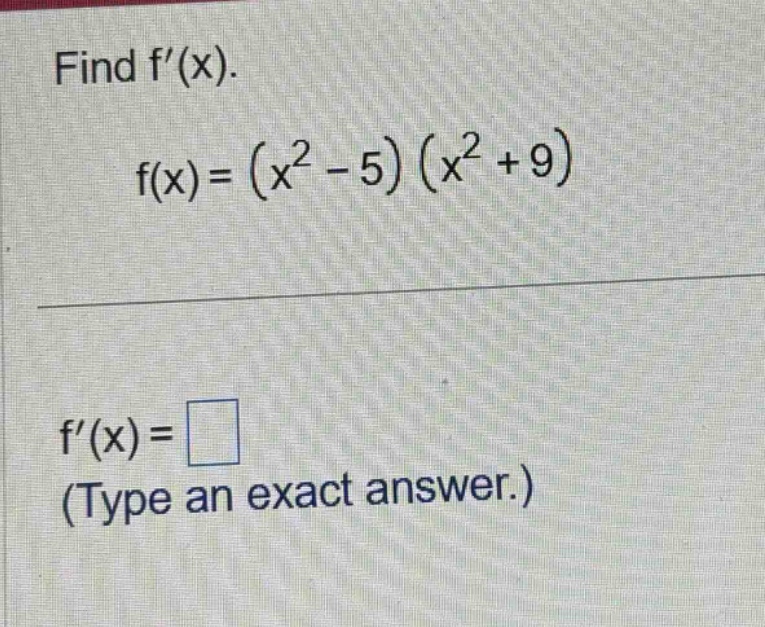
find f(x). f(x)=(x² - 5)(x² + 9) f(x)= (type an exact answer.)
Answer
Explanation:
Step1: Apply product - rule
The product - rule states that if $y = u\cdot v$, then $y^\prime=u^\prime v + uv^\prime$. Let $u=x^{2}-5$ and $v = x^{2}+9$.
Step2: Find $u^\prime$ and $v^\prime$
Differentiate $u=x^{2}-5$ with respect to $x$. Using the power - rule $\frac{d}{dx}(x^{n})=nx^{n - 1}$, we have $u^\prime=\frac{d}{dx}(x^{2}-5)=2x$. Differentiate $v=x^{2}+9$ with respect to $x$, then $v^\prime=\frac{d}{dx}(x^{2}+9)=2x$.
Step3: Substitute into product - rule
$f^\prime(x)=u^\prime v+uv^\prime=(2x)(x^{2}+9)+(x^{2}-5)(2x)$.
Step4: Expand and simplify
[ \begin{align*} f^\prime(x)&=2x\cdot x^{2}+2x\cdot9 + 2x\cdot x^{2}-2x\cdot5\ &=2x^{3}+18x + 2x^{3}-10x\ &=(2x^{3}+2x^{3})+(18x - 10x)\ &=4x^{3}+8x \end{align*} ]
Answer:
$4x^{3}+8x$