find the value of the following function at x = 2 and x = 3. does the intermediate value theorem guarantee…
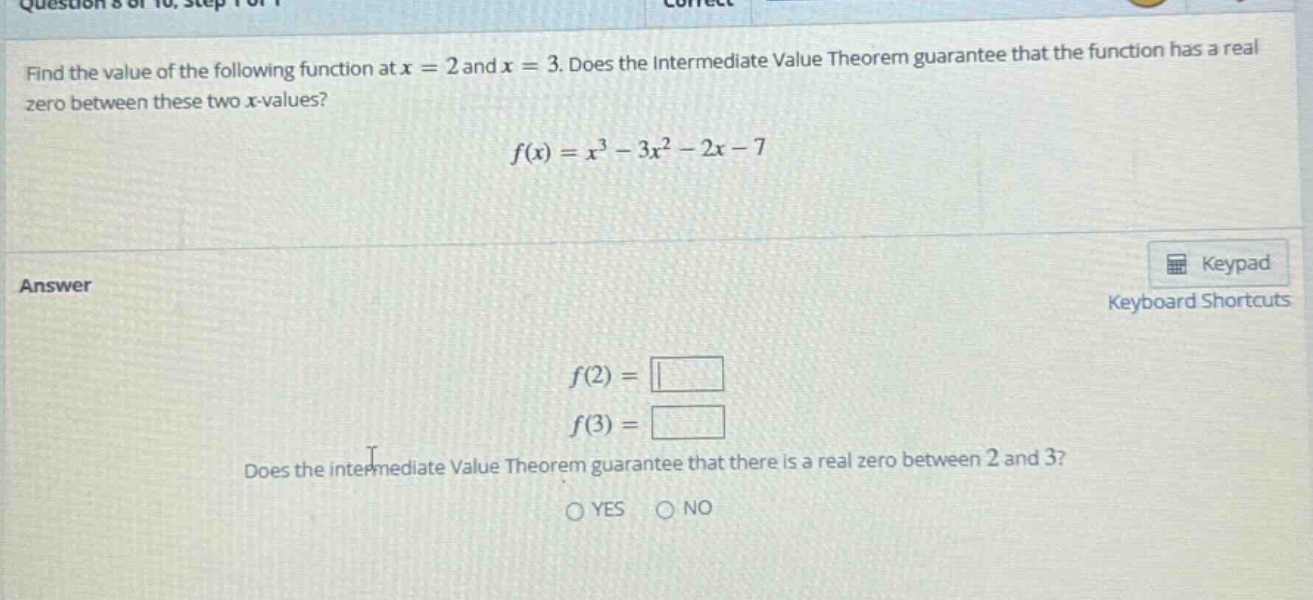
find the value of the following function at x = 2 and x = 3. does the intermediate value theorem guarantee that the function has a real zero between these two x - values? f(x)=x^3 - 3x^2 - 2x - 7 answer f(2)= f(3)= does the intermediate value theorem guarantee that there is a real zero between 2 and 3? yes no
Answer
Explanation:
Step1: Calculate f(2)
Substitute (x = 2) into (f(x)=x^{3}-3x^{2}-2x - 7). [ \begin{align*} f(2)&=2^{3}-3\times2^{2}-2\times2 - 7\ &=8-3\times4 - 4-7\ &=8 - 12-4 - 7\ &=-15 \end{align*} ]
Step2: Calculate f(3)
Substitute (x = 3) into (f(x)=x^{3}-3x^{2}-2x - 7). [ \begin{align*} f(3)&=3^{3}-3\times3^{2}-2\times3 - 7\ &=27-3\times9-6 - 7\ &=27 - 27-6 - 7\ &=-13 \end{align*} ]
Step3: Apply Intermediate - Value Theorem
The Intermediate - Value Theorem states that if a function (y = f(x)) is continuous on a closed interval ([a,b]), and (k) is a number between (f(a)) and (f(b)), then there exists at least one number (c) in the interval ((a,b)) such that (f(c)=k). For a real - zero, (k = 0). Since (f(2)=-15) and (f(3)=-13), and (0) is not between (-15) and (-13), the Intermediate - Value Theorem does not guarantee a real zero between (2) and (3).
Answer:
(f(2)=-15) (f(3)=-13) NO