find all values x = a where the function is discontinuous. for each value of x, give the limit of the…
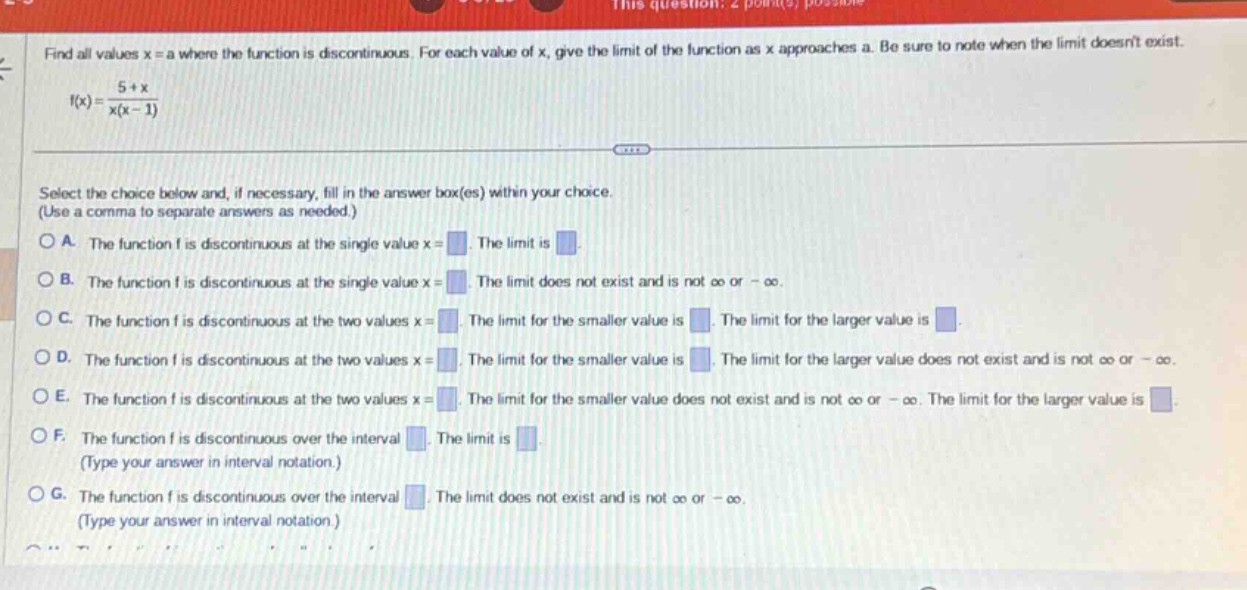
find all values x = a where the function is discontinuous. for each value of x, give the limit of the function as x approaches a. be sure to note when the limit doesnt exist. f(x) = (5 + x)/(x(x - 1)) select the choice below and, if necessary, fill in the answer box(es) within your choice. (use a comma to separate answers as needed.) a. the function f is discontinuous at the single value x = . the limit is . b. the function f is discontinuous at the single value x = . the limit does not exist and is not ∞ or -∞. c. the function f is discontinuous at the two values x = . the limit for the smaller value is . the limit for the larger value is . d. the function f is discontinuous at the two values x = . the limit for the smaller value is . the limit for the larger value does not exist and is not ∞ or -∞. e. the function f is discontinuous at the two values x = . the limit for the smaller value does not exist and is not ∞ or -∞. the limit for the larger value is . f. the function f is discontinuous over the interval . the limit is . (type your answer in interval notation.) g. the function f is discontinuous over the interval . the limit does not exist and is not ∞ or -∞. (type your answer in interval notation.)
Answer
Explanation:
Step1: Find discontinuity points
A rational - function $f(x)=\frac{5 + x}{x(x - 1)}$ is discontinuous where the denominator is zero. Set $x(x - 1)=0$. Solving $x(x - 1)=0$ gives $x = 0$ and $x = 1$.
Step2: Find the limit as $x\to0$
$\lim_{x\to0}\frac{5 + x}{x(x - 1)}=\lim_{x\to0}\frac{5 + x}{x^{2}-x}$. As $x\to0$, the numerator approaches $5$ and the denominator approaches $0$. The limit does not exist and is not $\infty$ or $-\infty$ since the sign of the denominator changes on either side of $x = 0$.
Step3: Find the limit as $x\to1$
$\lim_{x\to1}\frac{5 + x}{x(x - 1)}=\lim_{x\to1}\frac{5 + x}{x^{2}-x}$. As $x\to1$, the numerator is $6$ and the denominator approaches $0$. The limit does not exist and is not $\infty$ or $-\infty$ since the sign of the denominator changes on either side of $x = 1$.
Answer:
D. The function $f$ is discontinuous at the two values $x = 0,1$. The limit for the smaller value is does not exist and is not $\infty$ or $-\infty$. The limit for the larger value does not exist and is not $\infty$ or $-\infty$.