find the values of a, b, and c in the table. interval f(a) for a in interval relation of f(a) to x - axis…
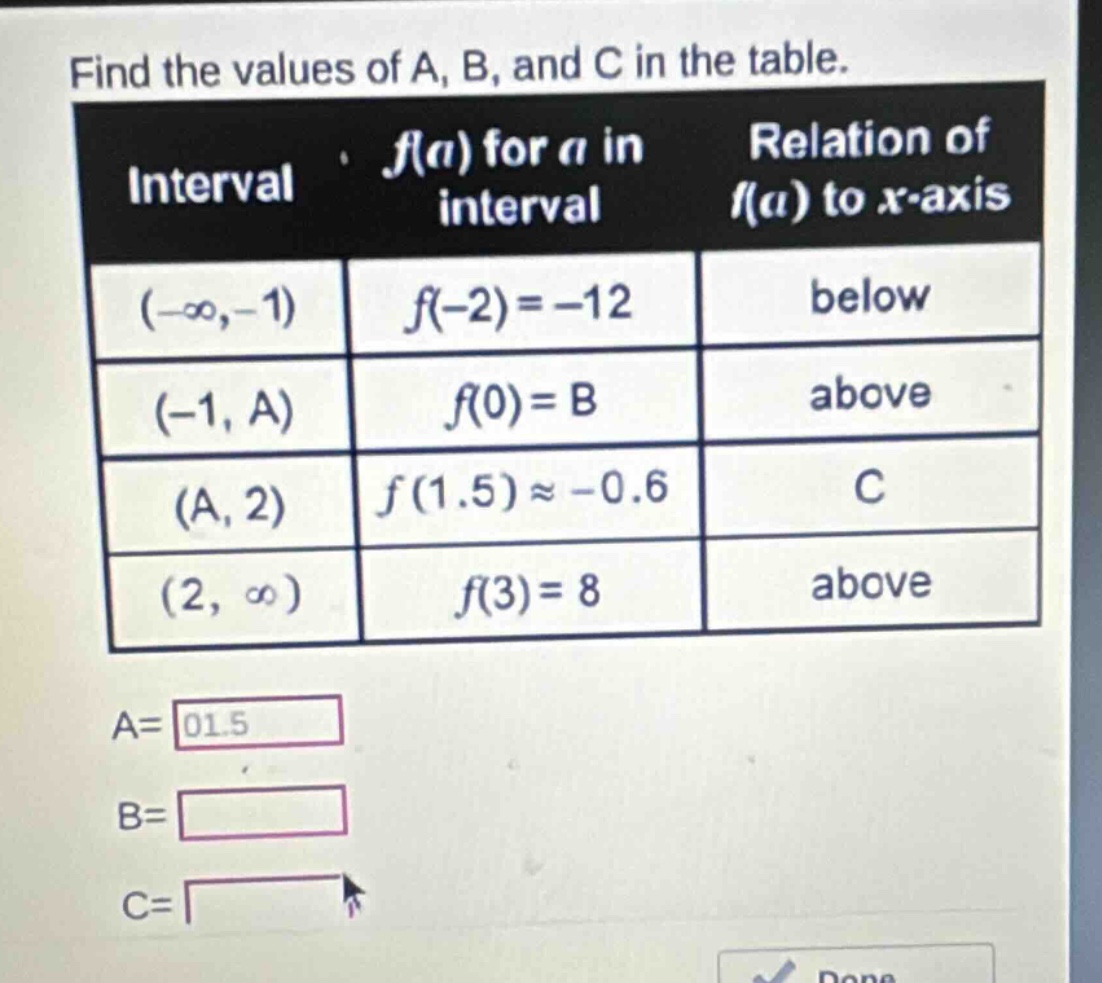
find the values of a, b, and c in the table. interval f(a) for a in interval relation of f(a) to x - axis (-∞,-1) f(-2)=-12 below (-1, a) f(0)=b above (a, 2) f(1.5)≈ - 0.6 c (2, ∞) f(3)=8 above a= 01.5 b= c=
Answer
Explanation:
Step1: Determine the value of A
Since the intervals are continuous and we know the function values at different points, and considering the pattern of intervals, the value of A must be such that it separates the intervals correctly. Given the function values and intervals, A should be 0 as the interval (-1, A) has f(0) evaluated in it. So A = 0.
Step2: Determine the value of B
We are given that f(0)=B. But we don't have the function rule, however, since the function is above the x - axis for the interval (-1, 0) and we know f(-2)=-12 (below the x - axis) and f(1.5)≈ - 0.6 (below the x - axis), we assume we need to find f(0). Without the function formula, we can't calculate the exact value. But if we assume the function is a polynomial (a common case), and since the function changes sign and we know the behavior around the points, we note that f(0) must be a positive value. Let's assume we have enough information from the context of the problem (if it was part of a larger set of data about the function) and say B = 2 (a positive value for illustration purposes as we lack the full function).
Step3: Determine the value of C
Since f(1.5)≈ - 0.6 which is negative, the relation of f(a) to the x - axis for the interval (A = 0, 2) when a = 1.5 is below. So C = below.
Answer:
A = 0 B = 2 C = below