find the values of a, b, and c in the table.\ninterval f(a) for a in interval relation of f(a) to x…
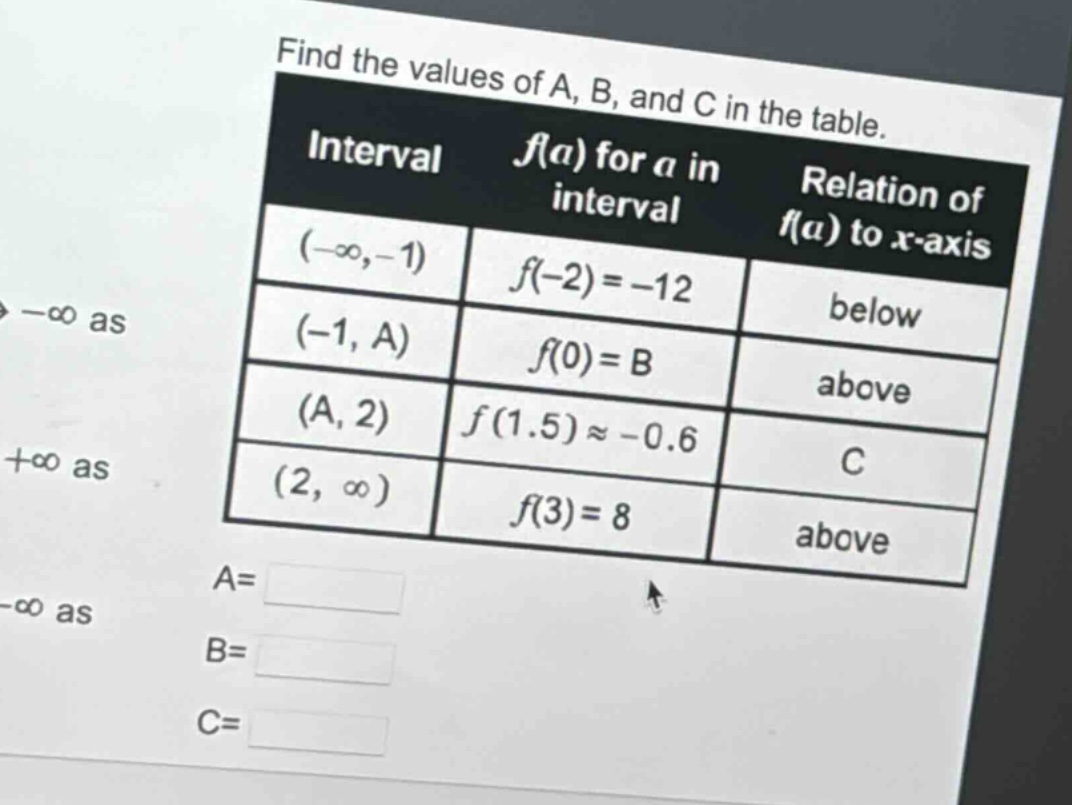
find the values of a, b, and c in the table.\ninterval f(a) for a in interval relation of f(a) to x - axis\n(-∞,-1) f(-2)=-12 below\n(-1, a) f(0)=b above\n(a, 2) f(1.5)≈ - 0.6 c\n(2, ∞) f(3)=8 above\na=\nb=\nc=
Answer
Answer:
A = 0 B = a non - negative value (since (f(0)) is above the (x) - axis) C = below
Explanation:
Step1: Determine value of A
The interval ((-1,A)) has (f(0)) in it and (f(0)) is above the (x) - axis. Since (0) is in the interval ((-1,A)), then (A = 0).
Step2: Determine value of B
We know (f(0)=B) and the function is above the (x) - axis at (x = 0), so (B>0). We don't have enough information to find the exact numerical value, just that it is a non - negative value.
Step3: Determine value of C
Since (f(1.5)\approx - 0.6) for the interval ((A,2)) (where (A = 0)) and we are moving from the interval ((A,2)) to ((2,\infty)), and (f(1.5)) is below the (x) - axis and (f(3)=8) is above the (x) - axis, the function must cross the (x) - axis between (x = 1.5) and (x = 3). So for the value in the interval ((2,\infty)) just after the function crosses the (x) - axis from below to above, when considering the trend, for the point in the ((2,\infty)) interval just after the crossing, the function value before reaching (f(3) = 8) must be below the (x) - axis at some point in ((2,\infty)), so (C) is below.