find the vertex.\n$f(x) = 3x^2 + 2x - 1$\n$(-\\frac{?}{\\square}, -\\frac{\\square}{\\square})$
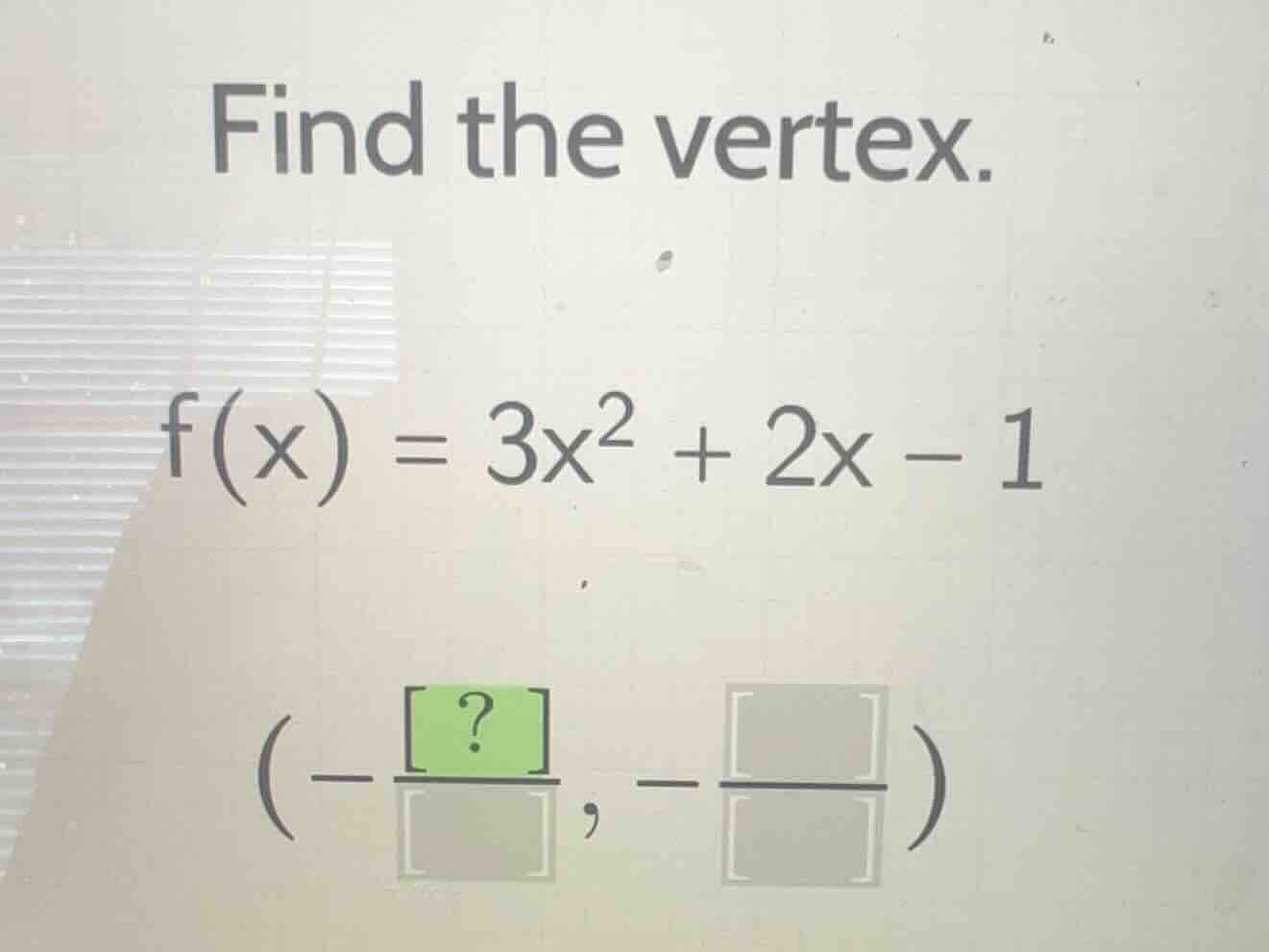
find the vertex.\n$f(x) = 3x^2 + 2x - 1$\n$(-\\frac{?}{\\square}, -\\frac{\\square}{\\square})$
Answer
Explanation:
Step1: Find the x - coordinate of the vertex
For a quadratic function ( f(x)=ax^{2}+bx + c ), the x - coordinate of the vertex is given by ( x=-\frac{b}{2a} ). In the function ( f(x)=3x^{2}+2x - 1 ), ( a = 3 ) and ( b = 2 ). So, ( x=-\frac{2}{2\times3}=-\frac{2}{6}=-\frac{1}{3} ). The x - coordinate of the vertex is ( -\frac{1}{3} ), which can be written as ( -\frac{1}{3}=-\frac{1}{3} ), so the numerator of the x - coordinate fraction is 1 and the denominator is 3.
Step2: Find the y - coordinate of the vertex
Substitute ( x = -\frac{1}{3} ) into the function ( f(x)=3x^{2}+2x - 1 ). First, calculate ( 3x^{2} ): ( 3\times\left(-\frac{1}{3}\right)^{2}=3\times\frac{1}{9}=\frac{1}{3} ) Then, calculate ( 2x ): ( 2\times\left(-\frac{1}{3}\right)=-\frac{2}{3} ) Now, substitute these values into the function: ( f\left(-\frac{1}{3}\right)=\frac{1}{3}-\frac{2}{3}-1 ) ( \frac{1}{3}-\frac{2}{3}=\frac{1 - 2}{3}=-\frac{1}{3} ) Then, ( -\frac{1}{3}-1=-\frac{1}{3}-\frac{3}{3}=-\frac{4}{3} ) So the y - coordinate of the vertex is ( -\frac{4}{3} ), where the numerator is 4 and the denominator is 3.
Answer:
For the x - coordinate fraction ( -\frac{\boldsymbol{1}}{\boldsymbol{3}} ) and for the y - coordinate fraction ( -\frac{\boldsymbol{4}}{\boldsymbol{3}} ) (so the first blank is 1, the second blank (denominator of x - coordinate) is 3, the third blank (numerator of y - coordinate) is 4, the fourth blank (denominator of y - coordinate) is 3). If we consider the vertex form of the answer as ( \left(-\frac{1}{3},-\frac{4}{3}\right) ), the values in the blanks are 1, 3, 4, 3 respectively.