7) find the vertical asymptote(s). f(x) = (x^2 - 4x + 4)/(x^2 - 7x + 12) x = 4 x = -4 x = -12 x = 3 x = -3
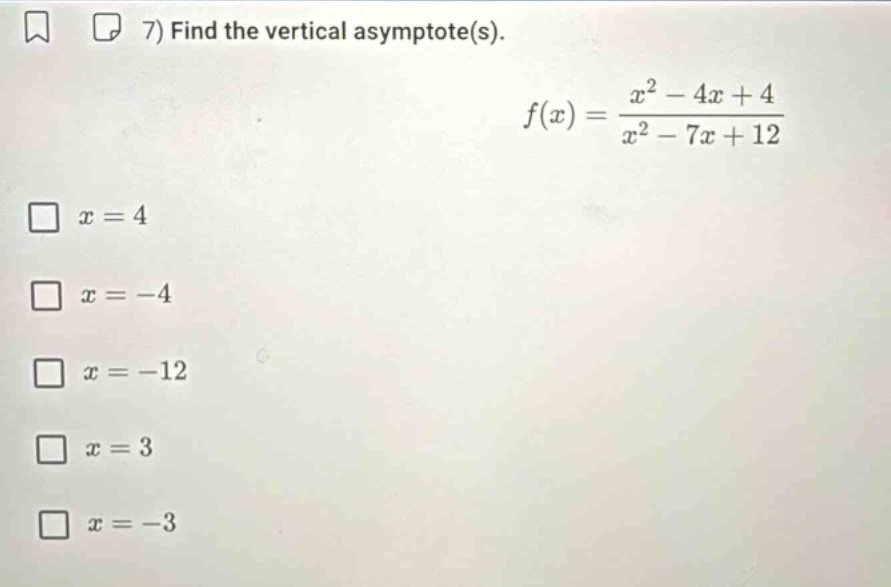
7) find the vertical asymptote(s). f(x) = (x^2 - 4x + 4)/(x^2 - 7x + 12) x = 4 x = -4 x = -12 x = 3 x = -3
Answer
Explanation:
Step1: Factor the denominator
Factor $x^{2}-7x + 12$ as $(x - 3)(x - 4)$. So $f(x)=\frac{x^{2}-4x + 4}{(x - 3)(x - 4)}$.
Step2: Find values that make denominator 0
Set the denominator equal to 0: $(x - 3)(x - 4)=0$. Using the zero - product property, $x-3 = 0$ gives $x = 3$ and $x - 4=0$ gives $x = 4$. These are the potential vertical asymptotes.
Step3: Check for removable discontinuities
Factor the numerator $x^{2}-4x + 4=(x - 2)^{2}$. Since there are no common factors between the numerator and the denominator that can be canceled out, $x = 3$ and $x = 4$ are vertical asymptotes.
Answer:
$x = 3$, $x = 4$