find the volume of the described solid of revolution or state that it does not exist. the region bounded by…
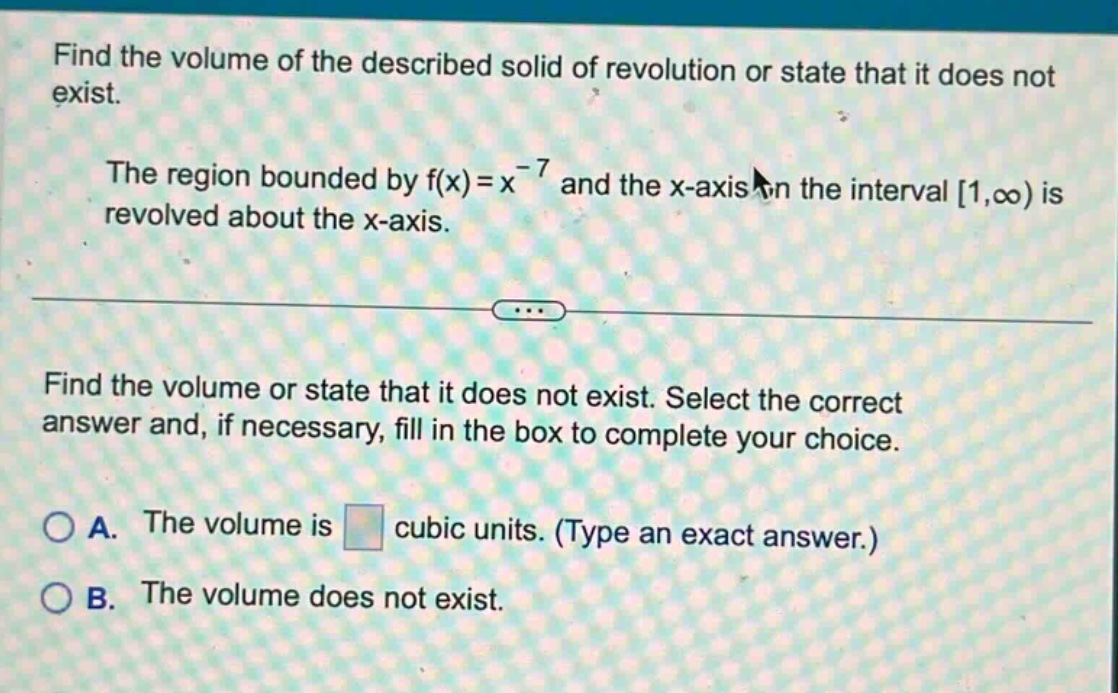
find the volume of the described solid of revolution or state that it does not exist. the region bounded by f(x)=x^(-7) and the x - axis on the interval 1,∞) is revolved about the x - axis. find the volume or state that it does not exist. select the correct answer and, if necessary, fill in the box to complete your choice. a. the volume is cubic units. (type an exact answer.) b. the volume does not exist.
Answer
Explanation:
Step1: Recall volume - of - revolution formula
The volume $V$ of the solid of revolution about the $x$-axis using the disk method is given by $V=\pi\int_{a}^{b}[f(x)]^{2}dx$. Here, $a = 1$, $b=\infty$, and $f(x)=x^{-7}$. So, $V=\pi\int_{1}^{\infty}(x^{-7})^{2}dx=\pi\int_{1}^{\infty}x^{- 14}dx$.
Step2: Evaluate the improper integral
The improper integral $\int_{1}^{\infty}x^{-14}dx=\lim_{t\rightarrow\infty}\int_{1}^{t}x^{-14}dx$. Using the power - rule for integration $\int x^{n}dx=\frac{x^{n + 1}}{n+1}+C$ ($n\neq - 1$), we have $\lim_{t\rightarrow\infty}\int_{1}^{t}x^{-14}dx=\lim_{t\rightarrow\infty}\left[\frac{x^{-14 + 1}}{-14+1}\right]{1}^{t}=\lim{t\rightarrow\infty}\left[\frac{x^{-13}}{-13}\right]_{1}^{t}$.
Step3: Calculate the limit
$\lim_{t\rightarrow\infty}\left[\frac{x^{-13}}{-13}\right]{1}^{t}=\lim{t\rightarrow\infty}\left(-\frac{1}{13t^{13}}+\frac{1}{13}\right)$. As $t\rightarrow\infty$, $\frac{1}{13t^{13}}\rightarrow0$. So, $\lim_{t\rightarrow\infty}\left(-\frac{1}{13t^{13}}+\frac{1}{13}\right)=\frac{1}{13}$.
Step4: Find the volume
Since $V=\pi\int_{1}^{\infty}x^{-14}dx$, and $\int_{1}^{\infty}x^{-14}dx=\frac{1}{13}$, then $V = \frac{\pi}{13}$.
Answer:
A. The volume is $\frac{\pi}{13}$ cubic units.