find the volume of the following solids. the base of a solid is the region between the curve y =…
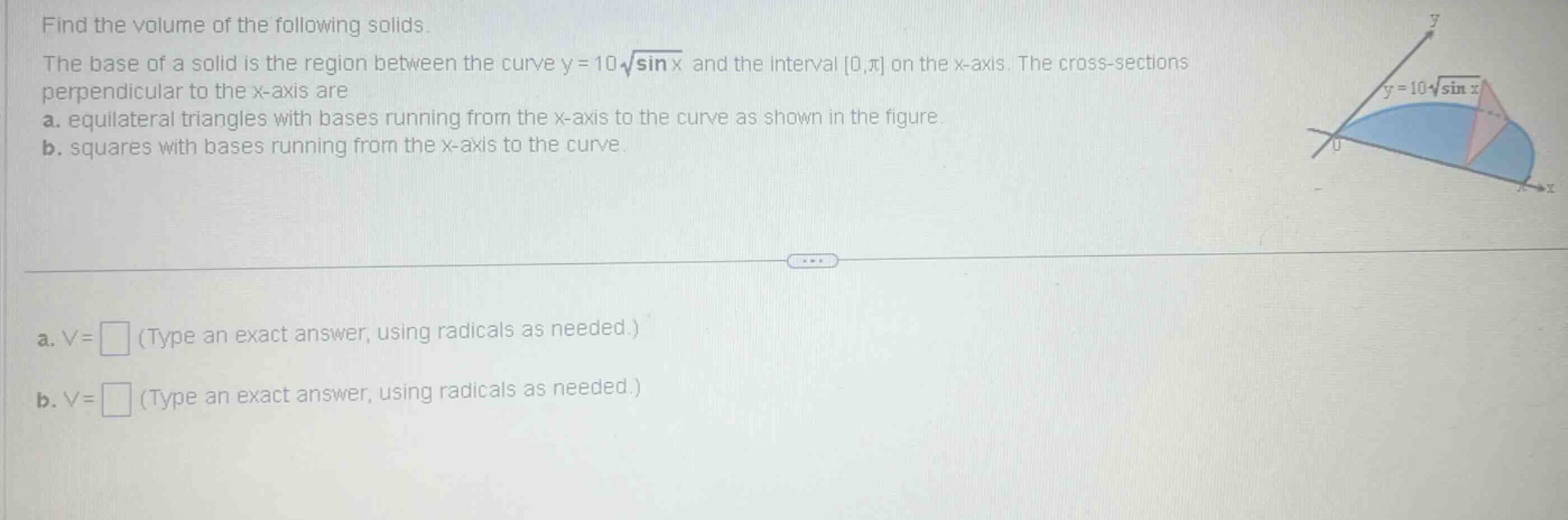
find the volume of the following solids. the base of a solid is the region between the curve y = 10\\sqrt{\\sin x} and the interval 0,\\pi on the x - axis. the cross - sections perpendicular to the x - axis are a. equilateral triangles with bases running from the x - axis to the curve as shown in the figure. b. squares with bases running from the x - axis to the curve. a. v = (type an exact answer, using radicals as needed.) b. v = (type an exact answer, using radicals as needed.)
Answer
Explanation:
Step1: Recall volume - by - cross - section formula
The volume $V$ of a solid with cross - sectional area $A(x)$ over the interval $[a,b]$ is given by $V=\int_{a}^{b}A(x)dx$. Here, $a = 0$, $b=\pi$, and the height of the curve is $y = 10\sqrt{\sin x}$.
Step2: Find the cross - sectional area for equilateral triangles
The base of the equilateral triangle $b = 10\sqrt{\sin x}$. The area of an equilateral triangle with side length $s$ is $A=\frac{\sqrt{3}}{4}s^{2}$. Here, $s = 10\sqrt{\sin x}$, so $A(x)=\frac{\sqrt{3}}{4}(10\sqrt{\sin x})^{2}=\frac{\sqrt{3}}{4}\times100\sin x = 25\sqrt{3}\sin x$. Then, $V=\int_{0}^{\pi}25\sqrt{3}\sin xdx$. Integrating $\sin x$ gives $-\cos x$. So, $V = 25\sqrt{3}[-\cos x]_{0}^{\pi}=25\sqrt{3}[-\cos\pi+\cos0]=25\sqrt{3}(1 + 1)=50\sqrt{3}$.
Step3: Find the cross - sectional area for squares
The base of the square $b = 10\sqrt{\sin x}$. The area of a square with side length $s$ is $A=s^{2}$. Here, $s = 10\sqrt{\sin x}$, so $A(x)=(10\sqrt{\sin x})^{2}=100\sin x$. Then, $V=\int_{0}^{\pi}100\sin xdx$. Integrating $\sin x$ gives $-\cos x$. So, $V = 100[-\cos x]_{0}^{\pi}=100[-\cos\pi+\cos0]=100(1 + 1)=200$.
Answer:
a. $50\sqrt{3}$ b. $200$