finding limits using properties of limits question 15, 11.2.89 hw score: 83.33%, 14 of 15 points points: 0…
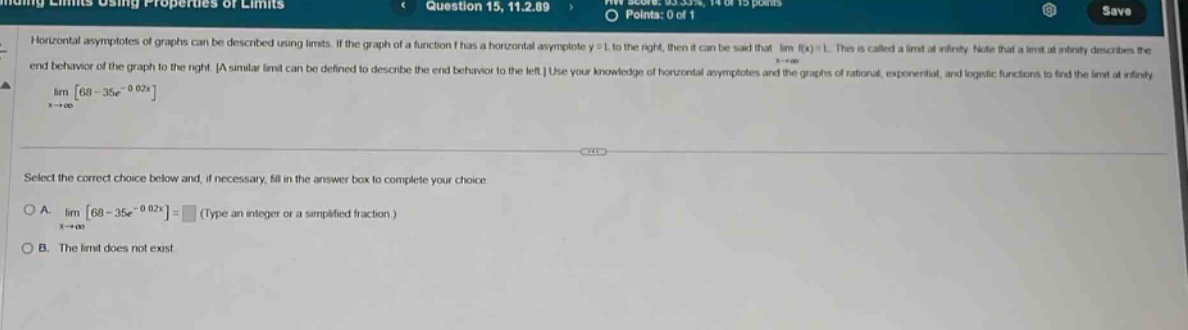
finding limits using properties of limits question 15, 11.2.89 hw score: 83.33%, 14 of 15 points points: 0 of 1 save horizontal asymptotes of graphs can be described using limits. if the graph of a function f has a horizontal asymptote y = l to the right, then it can be said that lim f(x)=l. this is called a limit at infinity. note that a limit at infinity describes the end - behavior of the graph to the right. a similar limit can be defined to describe the end - behavior to the left. use your knowledge of horizontal asymptotes and the graphs of rational, exponential, and logistic functions to find the limit at infinity. lim 68 - 35e^(-0.02x) x→+∞ select the correct choice below and, if necessary, fill in the answer box to complete your choice. a. lim 68 - 35e^(-0.02x) = (type an integer or a simplified fraction.) x→+∞ b. the limit does not exist
Answer
Explanation:
Step1: Recall exponential - limit property
As (x\to+\infty), for the function (y = e^{-ax}) where (a>0), (\lim_{x\to+\infty}e^{-ax}=0). Here (a = 0.02>0).
Step2: Evaluate the given limit
We have (\lim_{x\to+\infty}(68 - 35e^{-0.02x})). Using the difference - rule of limits (\lim_{x\to c}(f(x)-g(x))=\lim_{x\to c}f(x)-\lim_{x\to c}g(x)), so (\lim_{x\to+\infty}(68 - 35e^{-0.02x})=\lim_{x\to+\infty}68-35\lim_{x\to+\infty}e^{-0.02x}). Since (\lim_{x\to+\infty}68 = 68) and (\lim_{x\to+\infty}e^{-0.02x}=0), then (68-35\times0 = 68).
Answer:
A. (\lim_{x\to+\infty}(68 - 35e^{-0.02x})=68)