finding limits using tables and graphs\nthe graph of a function is given. use the graph to find the…
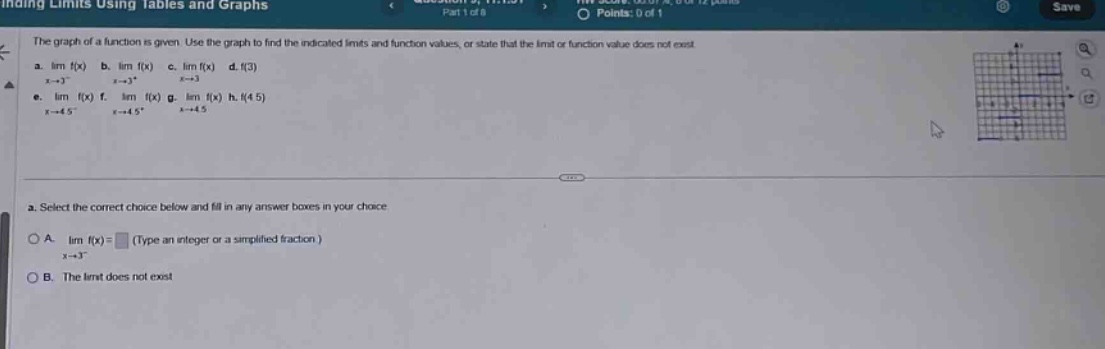
finding limits using tables and graphs\nthe graph of a function is given. use the graph to find the indicated limits and function values, or state that the limit or function value does not exist.\na. lim f(x) b. lim f(x) c. lim f(x) d. f(3)\nx→3− x→3+ x→3\ne. lim f(x) f. lim f(x) g. lim f(x) h. f(4.5)\nx→4.5− x→4.5+ x→4.5\na. select the correct choice below and fill in any answer boxes in your choice.\noa. lim f(x) = (type an integer or a simplified fraction.)\nx→3−\nb. the limit does not exist
Answer
Explanation:
Step1: Analyze left - hand limit
To find $\lim_{x\rightarrow3^{-}}f(x)$, we look at the behavior of the function $y = f(x)$ as $x$ approaches 3 from the left - hand side on the graph. We trace the graph as $x$ gets closer and closer to 3 from values less than 3.
Step2: Determine the value
Based on the graph (which is not shown here but the process is as follows), if the graph approaches a specific $y$ - value as $x\rightarrow3^{-}$, that $y$ - value is the limit. If the graph has a break or jumps as $x\rightarrow3^{-}$, the limit may not exist.
Since the graph is not provided, we cannot calculate the exact value. But the general process to find $\lim_{x\rightarrow3^{-}}f(x)$ is as described above.
Answer:
We cannot determine the answer without the graph.