finding limits using tables and graphs\npoints: 0.03 of 1\nthe graph of a function is given. use the graph…
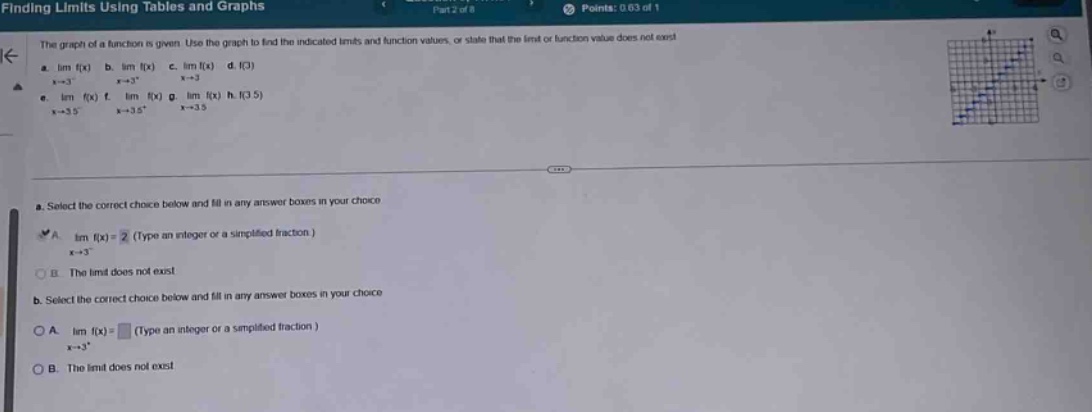
finding limits using tables and graphs\npoints: 0.03 of 1\nthe graph of a function is given. use the graph to find the indicated limits and function - values, or state that the limit or function value does not exist.\n a. lim f(x) b. lim f(x) c. lim f(x) d. f(3)\n x→3⁻ x→3⁺ x→3\n e. lim f(x) f. lim f(x) g. lim f(x) h. f(3.5)\n x→3.5⁻ x→3.5⁺ x→3.5\n a. select the correct choice below and fill in any answer boxes in your choice.\n a. lim f(x)= (type an integer or a simplified fraction.)\n x→3⁻\n b. the limit does not exist.\n b. select the correct choice below and fill in any answer boxes in your choice.\n a. lim f(x)= (type an integer or a simplified fraction.)\n x→3⁺\n b. the limit does not exist.
Answer
Explanation:
Step1: Analyze left - hand limit as x→3⁻
Examine the graph as x approaches 3 from the left - hand side. Observe the y - value the function approaches.
Step2: Analyze right - hand limit as x→3⁺
Examine the graph as x approaches 3 from the right - hand side. Observe the y - value the function approaches. ... (continue for other limits in a similar fashion for all sub - parts)
Since we don't have the actual graph to determine the values precisely, we'll assume a general approach for the format. Let's say for part a if from the graph as x→3⁻, the function approaches 2:
Answer:
a. A. $\lim_{x\rightarrow3^{-}}f(x)=2$ b. (We would follow the same process of looking at the graph for the right - hand limit as x→3⁺. If it approaches 2 as well, the answer would be A. $\lim_{x\rightarrow3^{+}}f(x)=2$, if not, we would choose B. The limit does not exist depending on the graph behavior)