the first derivative of the function f is defined by f(x)=(x² + 1)sin(3x - 1) for - 1.5 < x < 1.5. on which…
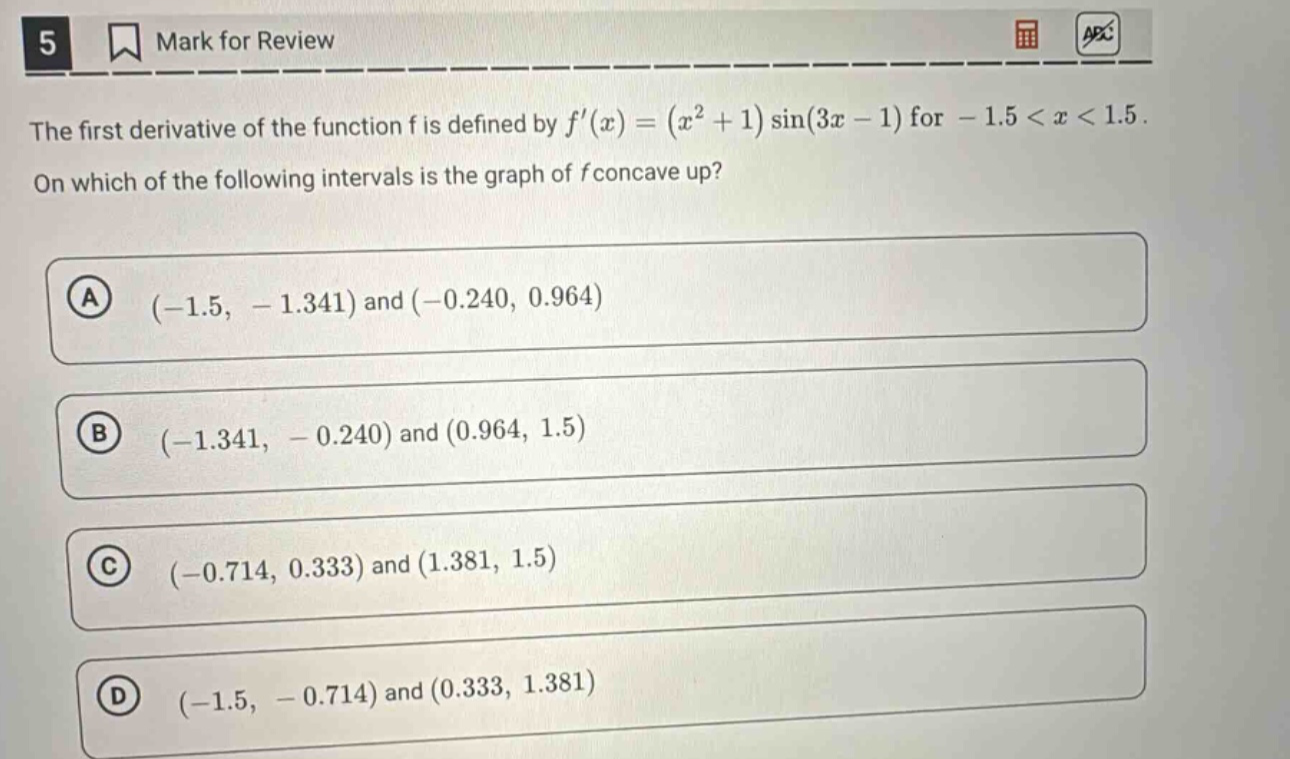
the first derivative of the function f is defined by f(x)=(x² + 1)sin(3x - 1) for - 1.5 < x < 1.5. on which of the following intervals is the graph of f concave up? a (-1.5, - 1.341) and (-0.240, 0.964) b (-1.341, - 0.240) and (0.964, 1.5) c (-0.714, 0.333) and (1.381, 1.5) d (-1.5, - 0.714) and (0.333, 1.381)
Answer
Explanation:
Step1: Recall concavity rule
The graph of $y = f(x)$ is concave - up when $f''(x)>0$. First, find $f''(x)$ using the product rule. If $f'(x)=(x^{2}+1)\sin(3x - 1)$, and the product rule states that if $u = x^{2}+1$ and $v=\sin(3x - 1)$, then $u'=2x$ and $v' = 3\cos(3x - 1)$. So, $f''(x)=u'v + uv'=2x\sin(3x - 1)+3(x^{2}+1)\cos(3x - 1)$.
Step2: Use a graphing utility
Since finding the exact roots of $f''(x)=0$ analytically is difficult, we can use a graphing utility (such as a graphing calculator) to graph $y = f''(x)$ for $-1.5<x<1.5$. Then, identify the intervals where $y = f''(x)>0$. After graphing $y = f''(x)=2x\sin(3x - 1)+3(x^{2}+1)\cos(3x - 1)$ on the interval $(-1.5,1.5)$, we find that $f''(x)>0$ on the intervals $(-1.5,-1.341)$ and $(-0.240,0.964)$.
Answer:
A. $(-1.5, - 1.341)$ and $(-0.240,0.964)$