first we will take a look at the function y = x² and various horizontal and vertical shifts or translations…
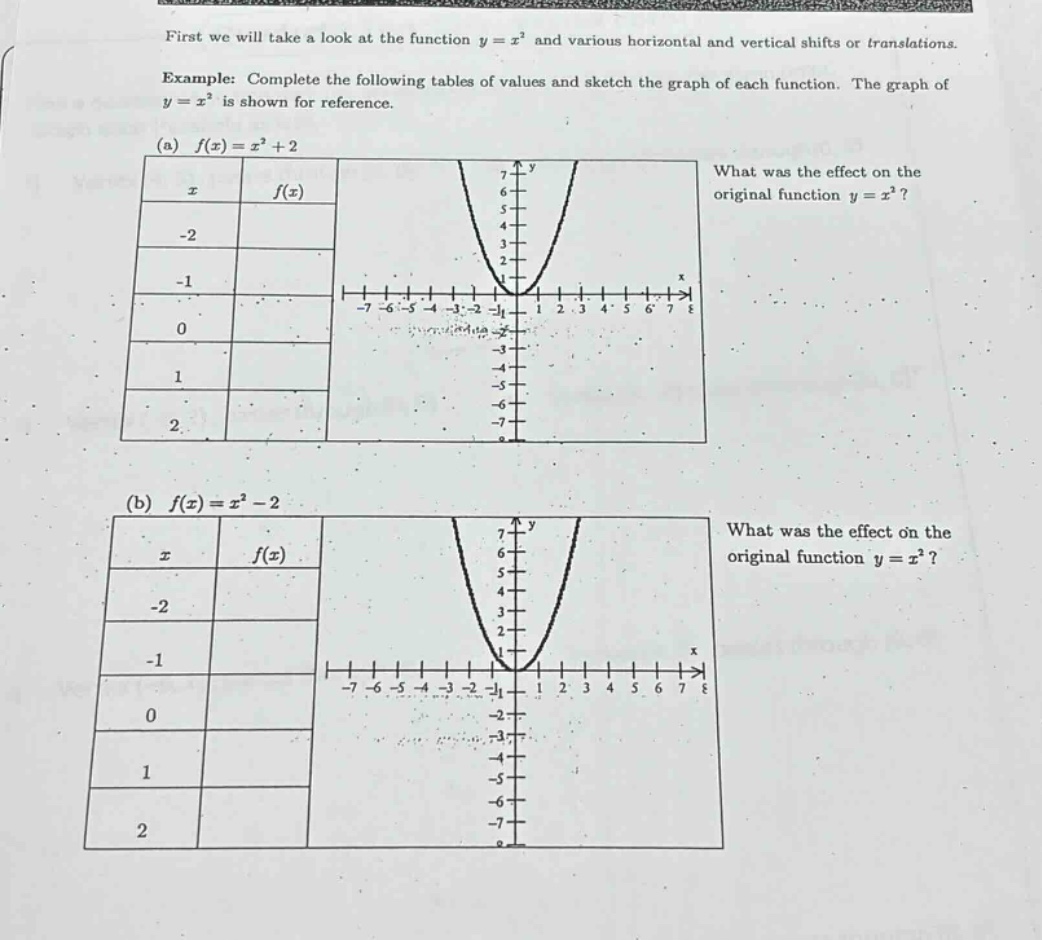
first we will take a look at the function y = x² and various horizontal and vertical shifts or translations. example: complete the following tables of values and sketch the graph of each function. the graph of y = x² is shown for reference. (a) f(x)=x² + 2 what was the effect on the original function y = x²? (b) f(x)=x² - 2 what was the effect on the original function y = x²?
Answer
Explanation:
Step1: Calculate values for (f(x)=x^{2}+2)
When (x = - 2), (f(-2)=(-2)^{2}+2=4 + 2=6); when (x=-1), (f(-1)=(-1)^{2}+2=1 + 2=3); when (x = 0), (f(0)=0^{2}+2=2); when (x = 1), (f(1)=1^{2}+2=1 + 2=3); when (x = 2), (f(2)=2^{2}+2=4 + 2=6). The effect on (y = x^{2}) is a vertical shift upwards by 2 units.
Step2: Calculate values for (f(x)=x^{2}-2)
When (x=-2), (f(-2)=(-2)^{2}-2=4-2 = 2); when (x=-1), (f(-1)=(-1)^{2}-2=1 - 2=-1); when (x = 0), (f(0)=0^{2}-2=-2); when (x = 1), (f(1)=1^{2}-2=1 - 2=-1); when (x = 2), (f(2)=2^{2}-2=4 - 2=2). The effect on (y = x^{2}) is a vertical shift downwards by 2 units.
| (x) | (f(x)=x^{2}+2) | (x) | (f(x)=x^{2}-2) |
|---|---|---|---|
| -2 | 6 | -2 | 2 |
| -1 | 3 | -1 | -1 |
| 0 | 2 | 0 | -2 |
| 1 | 3 | 1 | -1 |
| 2 | 6 | 2 | 2 |
Answer:
For (f(x)=x^{2}+2), the table values are as above and it shifts (y = x^{2}) up 2 units. For (f(x)=x^{2}-2), the table values are as above and it shifts (y = x^{2}) down 2 units.