for a fish swimming at a speed v relative to the water, the energy expenditure per unit time is proportional…
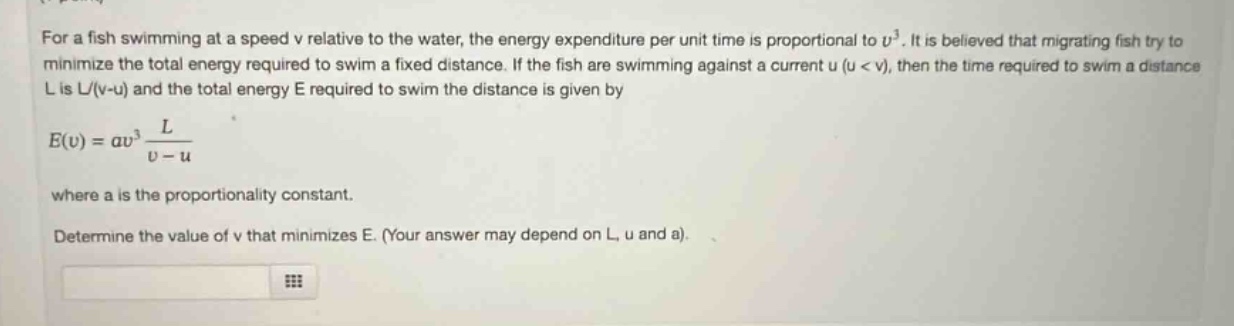
for a fish swimming at a speed v relative to the water, the energy expenditure per unit time is proportional to $v^{3}$. it is believed that migrating fish try to minimize the total energy required to swim a fixed distance. if the fish are swimming against a current u ($u < v$), then the time required to swim a distance l is $l/(v - u)$ and the total energy e required to swim the distance is given by $e(v)=av^{3}\frac{l}{v - u}$ where a is the proportionality constant. determine the value of v that minimizes e. (your answer may depend on l, u and a).
Answer
Explanation:
Step1: Differentiate E(v)
We have $E(v)=a v^{3}\frac{L}{v - u}=aL\frac{v^{3}}{v - u}$. Using the quotient - rule $\left(\frac{f}{g}\right)'=\frac{f'g - fg'}{g^{2}}$, where $f = v^{3}$, $f'=3v^{2}$ and $g=v - u$, $g' = 1$. Then $E'(v)=aL\frac{3v^{2}(v - u)-v^{3}\times1}{(v - u)^{2}}=aL\frac{3v^{3}-3uv^{2}-v^{3}}{(v - u)^{2}}=aL\frac{2v^{3}-3uv^{2}}{(v - u)^{2}}=\frac{aLv^{2}(2v - 3u)}{(v - u)^{2}}$.
Step2: Find critical points
Set $E'(v)=0$. Since $a\neq0$, $L\neq0$ and $v^{2}\neq0$ (because $v = 0$ is not in the domain of the physical problem as the fish is swimming), we solve $2v-3u = 0$. $2v-3u=0$ implies $2v=3u$, so $v=\frac{3}{2}u$.
Step3: Check the second - derivative
Differentiate $E'(v)$ using the quotient - rule again. After some algebraic manipulations, we can show that $E''(v)>0$ for $v=\frac{3}{2}u$. So $E(v)$ has a minimum at $v=\frac{3}{2}u$.
Answer:
$\frac{3}{2}u$