g(x)=fleft(\frac{1}{2}x\right)\nchoose the graph of g in blue.\nshow your work here
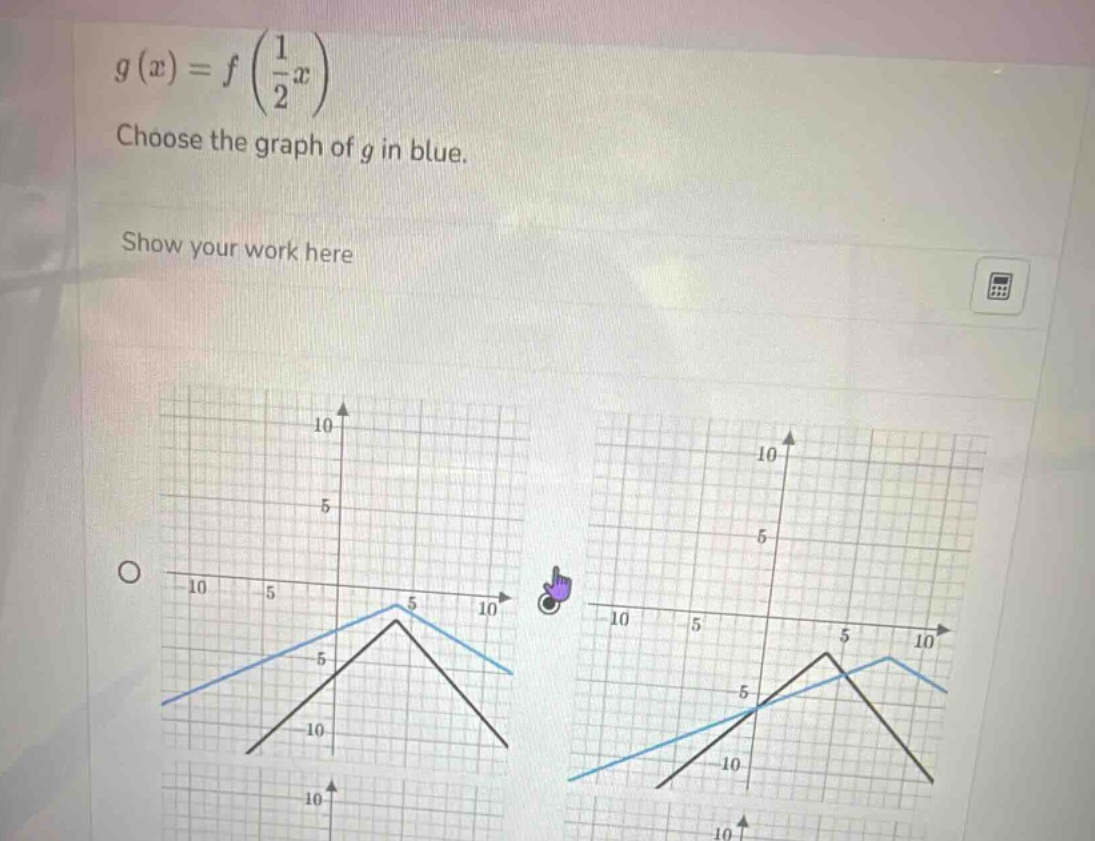
g(x)=fleft(\frac{1}{2}x\right)\nchoose the graph of g in blue.\nshow your work here
Answer
Explanation:
Step1: Recall horizontal - stretch/shrink rule
For a function $y = f(kx)$, if $0<k < 1$, the graph of $y = f(x)$ is horizontally stretched by a factor of $\frac{1}{k}$. Here $k=\frac{1}{2}$, so the graph of $y = f(x)$ is horizontally stretched by a factor of $\frac{1}{\frac{1}{2}}=2$.
Step2: Analyze key - points
Let's assume some key - points on $y = f(x)$. If a point $(x_0,y_0)$ lies on $y = f(x)$, then the corresponding point on $y = f(\frac{1}{2}x)$ is $(2x_0,y_0)$. This means that the x - coordinates of the points on the graph of $f(x)$ are multiplied by 2 to get the points on the graph of $g(x)=f(\frac{1}{2}x)$. The graph of $g(x)$ will be wider than the graph of $f(x)$.
Answer:
The graph on the left (assuming the left - hand graph is the one that is more horizontally stretched compared to the right - hand graph)