follow the steps for graphing a rational function to graph the function r(x) = x² / (x² - x - 20). determine…
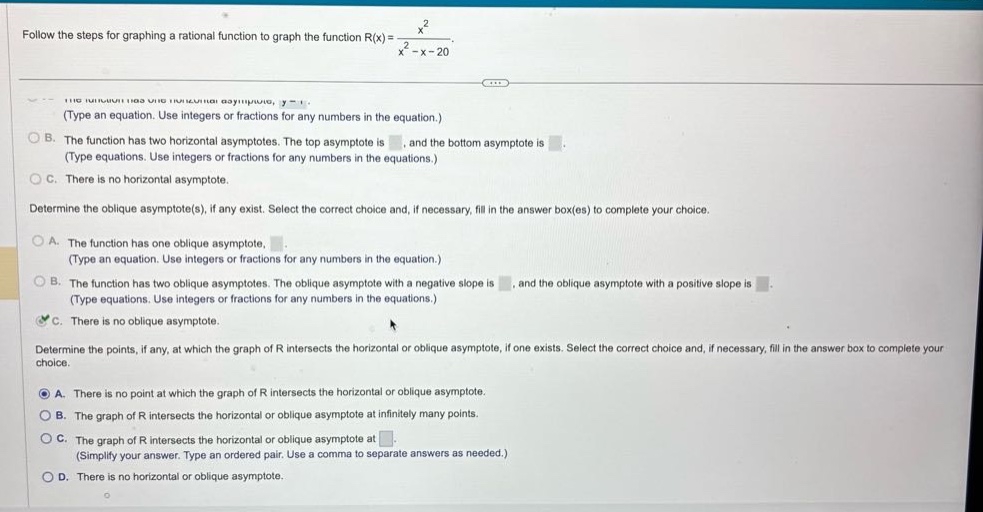
follow the steps for graphing a rational function to graph the function r(x) = x² / (x² - x - 20). determine the horizontal asymptote(s), if any exist. select the correct choice and, if necessary, fill in the answer box(es) to complete your choice. a. the function has one horizontal asymptote, y =. (type an equation. use integers or fractions for any numbers in the equation.) b. the function has two horizontal asymptotes. the top asymptote is, and the bottom asymptote is. (type equations. use integers or fractions for any numbers in the equations.) c. there is no horizontal asymptote. determine the oblique asymptote(s), if any exist. select the correct choice and, if necessary, fill in the answer box(es) to complete your choice. a. the function has one oblique asymptote,. (type an equation. use integers or fractions for any numbers in the equation.) b. the function has two oblique asymptotes. the oblique asymptote with a negative slope is, and the oblique asymptote with a positive slope is. (type equations. use integers or fractions for any numbers in the equations.) c. there is no oblique asymptote. determine the points, if any, at which the graph of r intersects the horizontal or oblique asymptote, if one exists. select the correct choice and, if necessary, fill in the answer box to complete your choice. a. there is no point at which the graph of r intersects the horizontal or oblique asymptote. b. the graph of r intersects the horizontal or oblique asymptote at infinitely many points. c. the graph of r intersects the horizontal or oblique asymptote at. (simplify your answer. type an ordered pair. use a comma to separate answers as needed.) d. there is no horizontal or oblique asymptote.
Answer
Explanation:
Step1: Find horizontal asymptote
For a rational function $R(x)=\frac{f(x)}{g(x)}$ where $f(x)=x^{2}$ and $g(x)=x^{2}-x - 20$, since the degrees of the numerator and denominator are the same (both degree 2), the horizontal asymptote is given by the ratio of the leading - coefficients. The leading coefficient of $f(x)$ is 1 and the leading coefficient of $g(x)$ is 1. So, $y = \frac{1}{1}=1$.
Step2: Check for oblique asymptote
Since the degree of the numerator is equal to the degree of the denominator, there is no oblique asymptote. An oblique asymptote occurs when the degree of the numerator is exactly one more than the degree of the denominator.
Step3: Check for intersection points
Set $R(x)=1$ (the horizontal asymptote). So, $\frac{x^{2}}{x^{2}-x - 20}=1$. Cross - multiply: $x^{2}=x^{2}-x - 20$. Subtracting $x^{2}$ from both sides gives $0=-x - 20$, or $x=-20$. But when $x = - 20$, the denominator $x^{2}-x - 20=(-20)^{2}-(-20)-20=400 + 20-20=400\neq0$. Substitute $x=-20$ into $R(x)$: $R(-20)=\frac{(-20)^{2}}{(-20)^{2}-(-20)-20}=1$. The point of intersection is $(-20,1)$.
Answer:
- For horizontal asymptote:
- A. $y = 1$
- For oblique asymptote:
- C. There is no oblique asymptote.
- For intersection points:
- C. $(-20,1)$