which of the following accurately lists all discontinuities of the function below? f(x)= { 4, x<-4; (x +…
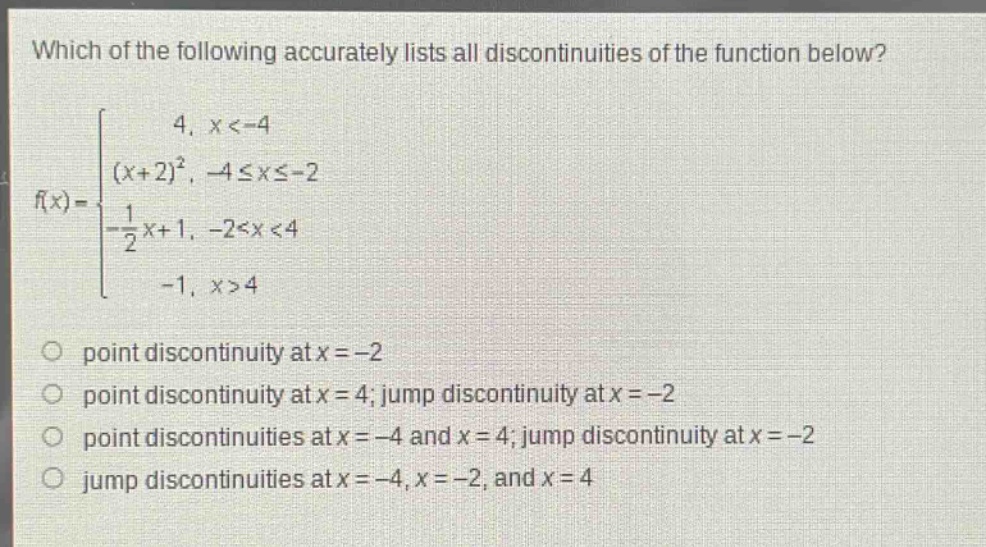
which of the following accurately lists all discontinuities of the function below? f(x)= { 4, x<-4; (x + 2)^2, -4≤x≤-2; -1/2x + 1, -2<x<4; -1, x>4 } point discontinuity at x=-2 point discontinuity at x = 4; jump discontinuity at x=-2 point discontinuities at x=-4 and x = 4; jump discontinuity at x=-2 jump discontinuities at x=-4, x=-2, and x = 4
Answer
Answer:
D. jump discontinuities at (x = - 4,x=-2,) and (x = 4)
Explanation:
Step1: Check (x=-4)
Left - hand limit: (\lim_{x\rightarrow - 4^{-}}f(x)=4). Right - hand limit: (\lim_{x\rightarrow - 4^{+}}f(x)=( - 4 + 2)^{2}=4). But the function changes its rule at (x=-4), creating a jump.
Step2: Check (x=-2)
Left - hand limit: (\lim_{x\rightarrow - 2^{-}}f(x)=( - 2+2)^{2}=0). Right - hand limit: (\lim_{x\rightarrow - 2^{+}}f(x)=-\frac{1}{2}\times(-2)+1 = 2). There is a jump.
Step3: Check (x = 4)
Left - hand limit: (\lim_{x\rightarrow4^{-}}f(x)=-\frac{1}{2}\times4 + 1=-1). Right - hand limit: (\lim_{x\rightarrow4^{+}}f(x)=-1). But the function changes its rule at (x = 4), creating a jump.