the following analysis was done to show the convergence of the sequence (d_n=ln(7^n)-ln(n!)). write (d_n =…
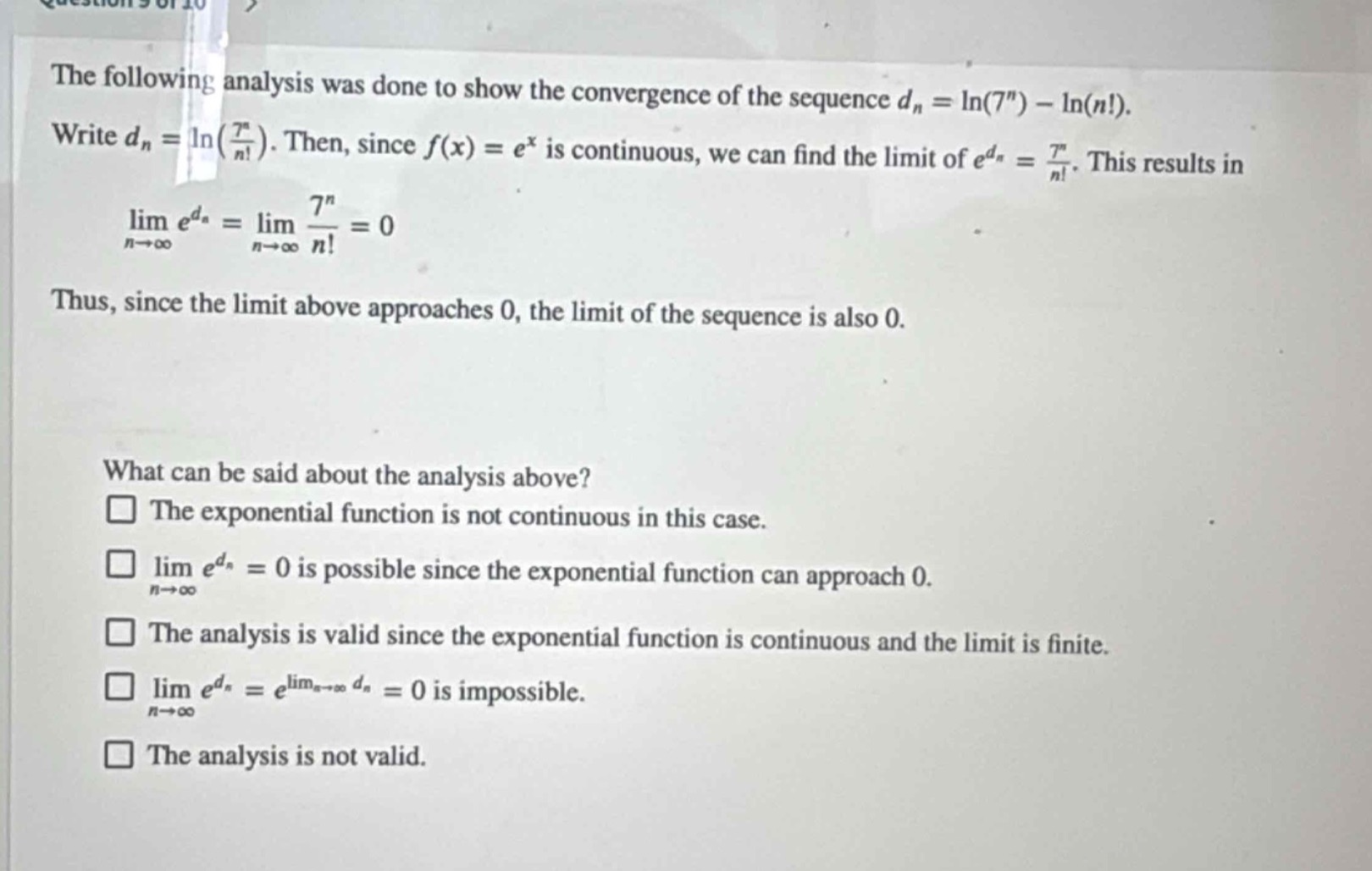
the following analysis was done to show the convergence of the sequence (d_n=ln(7^n)-ln(n!)). write (d_n = ln(\frac{7^n}{n!})). then, since (f(x)=e^x) is continuous, we can find the limit of (e^{d_n}=\frac{7^n}{n!}). this results in (lim_{n\rightarrowinfty}e^{d_n}=lim_{n\rightarrowinfty}\frac{7^n}{n!}=0). thus, since the limit above approaches 0, the limit of the sequence is also 0. what can be said about the analysis above? the exponential function is not continuous in this case. (lim_{n\rightarrowinfty}e^{d_n}=0) is possible since the exponential function can approach 0. the analysis is valid since the exponential function is continuous and the limit is finite. (lim_{n\rightarrowinfty}e^{d_n}=e^{lim_{n\rightarrowinfty}d_n}=0) is impossible. the analysis is not valid.
Answer
Explicación:
Paso 1: Propiedades de la función exponencial
La función $y = e^{x}$ es continua para todo $x\in\mathbb{R}$. Además, si $\lim_{n\rightarrow\infty}a_{n}=L$, entonces $\lim_{n\rightarrow\infty}e^{a_{n}}=e^{L}$ (por la continuidad de la función exponencial). Pero $y = e^{x}>0$ para todo $x\in\mathbb{R}$, y $\lim_{n\rightarrow\infty}e^{d_{n}} = 0$ no es posible, ya que el valor de la función exponencial real $y = e^{x}$ nunca alcanza $0$.
Respuesta:
$\lim_{n\rightarrow\infty}e^{d_{n}}=e^{\lim_{n\rightarrow\infty}d_{n}} = 0$ es imposible.