which of the following is an antiderivative of 3sec²x + 2? () a: 3tanx b: 3tanx + 2x c: 3secx + 2x d: sec³x…
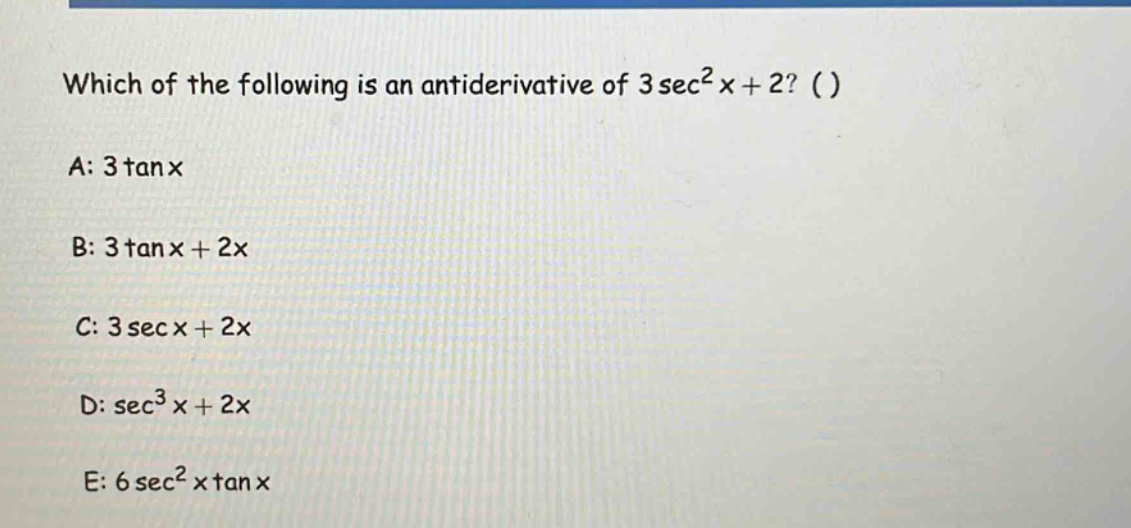
which of the following is an antiderivative of 3sec²x + 2? () a: 3tanx b: 3tanx + 2x c: 3secx + 2x d: sec³x + 2x e: 6sec²xtanx
Answer
Explanation:
Step1: Recall derivative formulas
We know that $\frac{d}{dx}(\tan x)=\sec^{2}x$ and $\frac{d}{dx}(x) = 1$.
Step2: Find antiderivative of each term
The antiderivative of $3\sec^{2}x$ is $3\tan x$ (since the derivative of $\tan x$ is $\sec^{2}x$ and by the constant - multiple rule of integration). The antiderivative of $2$ is $2x$ (because if $y = 2x$, then $\frac{dy}{dx}=2$).
Step3: Combine the antiderivatives
The antiderivative of $3\sec^{2}x + 2$ is $3\tan x+2x$.
Answer:
B. $3\tan x + 2x$