which of the following is an asymptote of $y = csc(x)$?\n$x = -pi$\n$x=-\frac{pi}{3}$\n$x =…
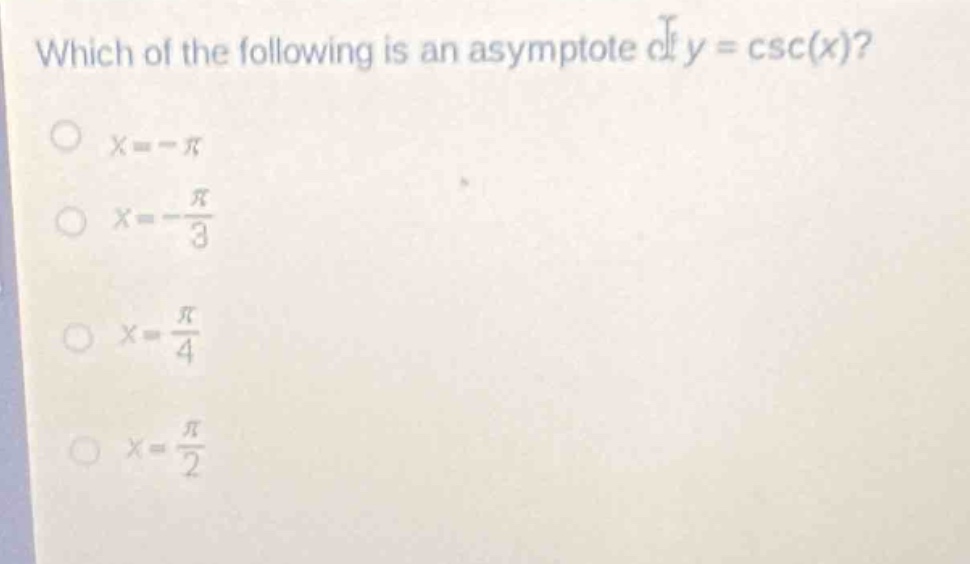
which of the following is an asymptote of $y = csc(x)$?\n$x = -pi$\n$x=-\frac{pi}{3}$\n$x = \frac{pi}{4}$\n$x=\frac{pi}{2}$
Answer
Explanation:
Step1: Recall the definition of cosecant function
The cosecant function is defined as $y = \csc(x)=\frac{1}{\sin(x)}$. Vertical asymptotes occur where $\sin(x)=0$.
Step2: Find the values of $x$ for which $\sin(x) = 0$
The sine - function $\sin(x)=0$ when $x = n\pi$, where $n\in\mathbb{Z}$ (integers).
Step3: Check the given options
When $n=- 1$, $x=-\pi$ and $\sin(-\pi)=0$. So, $x =-\pi$ is a vertical asymptote of $y = \csc(x)$. For $x=-\frac{\pi}{3}$, $\sin(-\frac{\pi}{3})=-\frac{\sqrt{3}}{2}\neq0$; for $x = \frac{\pi}{4}$, $\sin(\frac{\pi}{4})=\frac{\sqrt{2}}{2}\neq0$; for $x=\frac{\pi}{2}$, $\sin(\frac{\pi}{2}) = 1\neq0$.
Answer:
$x =-\pi$