which of the following could be f(x)? choose all possible answers (select all that apply.) ∫(x + 2)dx f(x) =…
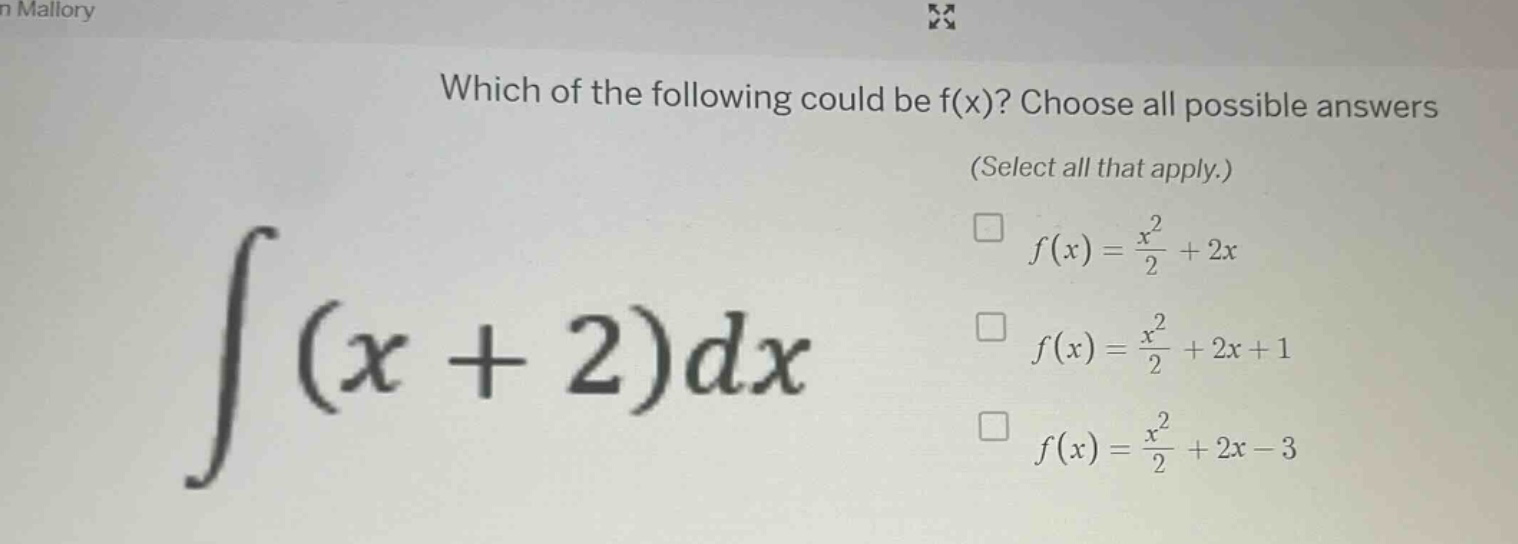
which of the following could be f(x)? choose all possible answers (select all that apply.) ∫(x + 2)dx f(x) = x²/2 + 2x f(x) = x²/2 + 2x + 1 f(x) = x²/2 + 2x - 3
Answer
Explanation:
Step1: Apply power - rule for integration
The power - rule for integration is $\int x^n dx=\frac{x^{n + 1}}{n+1}+C$ ($n\neq - 1$). For $\int(x + 2)dx$, we integrate term by term. $\int xdx+\int 2dx$. Since $\int xdx=\frac{x^{2}}{2}+C_1$ and $\int 2dx=2x + C_2$, then $\int(x + 2)dx=\frac{x^{2}}{2}+2x + C$, where $C = C_1 + C_2$ is an arbitrary constant.
Step2: Check each option
The antiderivative of $x + 2$ is of the form $\frac{x^{2}}{2}+2x + C$. When $C = 0$, $f(x)=\frac{x^{2}}{2}+2x$; when $C = 1$, $f(x)=\frac{x^{2}}{2}+2x + 1$; when $C=-3$, $f(x)=\frac{x^{2}}{2}+2x - 3$.
Answer:
$f(x)=\frac{x^{2}}{2}+2x$, $f(x)=\frac{x^{2}}{2}+2x + 1$, $f(x)=\frac{x^{2}}{2}+2x - 3$