which of the following definite integrals are equal to lim n→∞ ∑k = 1n sin(−1 + 5k/n) 5/n? i. ∫−14 sin x dx…
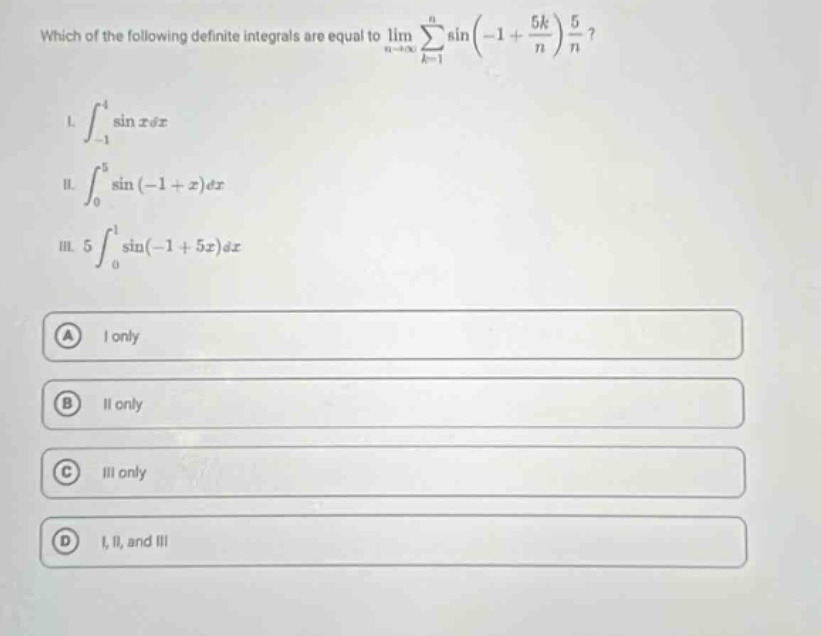
which of the following definite integrals are equal to lim n→∞ ∑k = 1n sin(−1 + 5k/n) 5/n? i. ∫−14 sin x dx ii. ∫05 sin(−1 + x) dx iii. 5 ∫01 sin(−1 + 5x) dx a i only b ii only c iii only d i, ii, and iii
Answer
Explanation:
Step1: Recall the definition of definite - integral as a limit of Riemann sum
The definite integral $\int_{a}^{b}f(x)dx=\lim_{n\rightarrow\infty}\sum_{k = 1}^{n}f(x_k)\Delta x$, where $\Delta x=\frac{b - a}{n}$ and $x_k=a + k\Delta x$.
Given $\lim_{n\rightarrow\infty}\sum_{k = 1}^{n}\sin(-1+\frac{5k}{n})\frac{5}{n}$, we have $\Delta x=\frac{5}{n}$ and $x_k=-1+\frac{5k}{n}$.
Step2: Determine the limits of integration and the function
From $\Delta x=\frac{b - a}{n}=\frac{5}{n}$, we get $b - a = 5$. And from $x_k=a + k\Delta x=-1+\frac{5k}{n}$, when $k = 0$, $x_0=a=-1$. Then $b=a + 5=4$. And $f(x)=\sin(x)$. So $\int_{a}^{b}f(x)dx=\int_{-1}^{4}\sin(x)dx$.
Step3: Check the second integral
For $\int_{0}^{5}\sin(-1 + x)dx$, let $u=-1 + x$, $du=dx$. When $x = 0$, $u=-1$; when $x = 5$, $u = 4$. So $\int_{0}^{5}\sin(-1 + x)dx=\int_{-1}^{4}\sin(u)du$.
Step4: Check the third integral
For $5\int_{0}^{1}\sin(-1+5x)dx$, let $t=-1 + 5x$, $dt = 5dx$. When $x = 0$, $t=-1$; when $x = 1$, $t = 4$. So $5\int_{0}^{1}\sin(-1+5x)dx=\int_{-1}^{4}\sin(t)dt$.
Answer:
D. I, II, and III