which of the following definite integrals are equal to lim_{n→∞}∑_{k = 1}^{n}(-2 + 8k/n)^38/n? i…
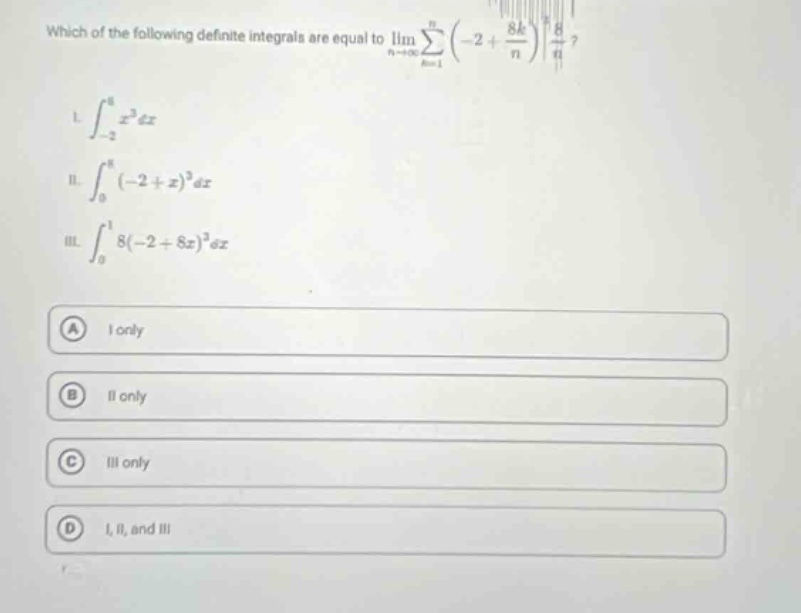
which of the following definite integrals are equal to lim_{n→∞}∑_{k = 1}^{n}(-2 + 8k/n)^38/n? i. ∫_{-2}^{6}x^3dx ii. ∫_{0}^{8}(-2 + x)^3dx iii. ∫_{0}^{1}8(-2 + 8x)^3dx a i only b ii only c iii only d i, ii, and iii
Answer
Explanation:
Step1: Recall the definition of definite - integral as a limit of Riemann sum
The definite integral $\int_{a}^{b}f(x)dx=\lim_{n\rightarrow\infty}\sum_{k = 1}^{n}f(x_k)\Delta x$, where $\Delta x=\frac{b - a}{n}$ and $x_k=a + k\Delta x$.
In the given limit $\lim_{n\rightarrow\infty}\sum_{k = 1}^{n}\left(-2+\frac{8k}{n}\right)^3\frac{8}{n}$, we have $\Delta x=\frac{8}{n}$ and $x_k=-2+\frac{8k}{n}$.
Step2: Determine $a$, $b$ and $f(x)$
Since $\Delta x=\frac{b - a}{n}=\frac{8}{n}$, then $b - a = 8$. And since $x_k=a + k\Delta x=-2+\frac{8k}{n}$, we can see that $a=-2$ and $b = 6$. Also, $f(x)=x^3$. So the definite - integral is $\int_{-2}^{6}x^3dx$.
Let's check each option:
- For option I: $\int_{-2}^{6}x^3dx$. Using the power - rule of integration $\int x^n dx=\frac{x^{n + 1}}{n+1}+C(n\neq - 1)$, we have $\left[\frac{x^{4}}{4}\right]_{-2}^{6}=\frac{6^{4}}{4}-\frac{(-2)^{4}}{4}=\frac{1296}{4}-\frac{16}{4}=324 - 4=320$.
- For option II: Let $u=-2 + x$, when $x = 0$, $u=-2$; when $x = 8$, $u = 6$. $\int_{0}^{8}(-2 + x)^3dx=\int_{-2}^{6}u^3du$ (by substitution $u=-2 + x$, $du=dx$).
- For option III: Let $u=-2+8x$, $du = 8dx$. When $x = 0$, $u=-2$; when $x = 1$, $u = 6$. $\int_{0}^{1}8(-2 + 8x)^3dx=\int_{-2}^{6}u^3du$ (by substitution).
Answer:
D. I, II, and III