which of the following could describe a single logarithmic function $f$?\n(a) $lim_{x\rightarrow0^{+}}f(x)=-i…
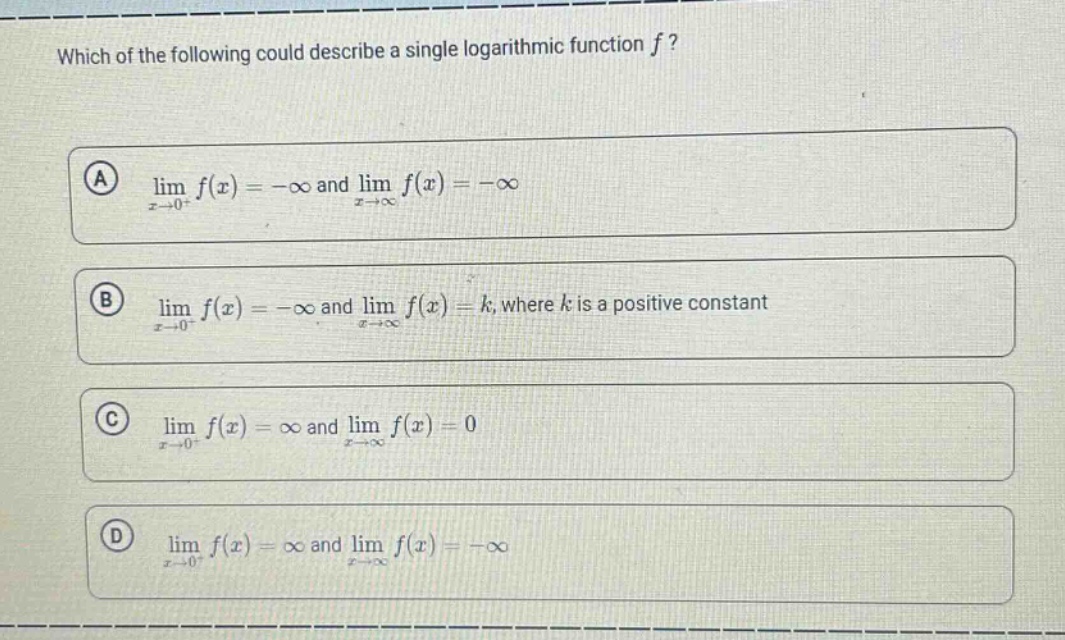
which of the following could describe a single logarithmic function $f$?\n(a) $lim_{x\rightarrow0^{+}}f(x)=-infty$ and $lim_{x\rightarrowinfty}f(x)=-infty$\n(b) $lim_{x\rightarrow0^{+}}f(x)=-infty$ and $lim_{x\rightarrowinfty}f(x)=k$, where $k$ is a positive constant\n(c) $lim_{x\rightarrow0^{+}}f(x)=infty$ and $lim_{x\rightarrowinfty}f(x)=0$\n(d) $lim_{x\rightarrow0^{+}}f(x)=infty$ and $lim_{x\rightarrowinfty}f(x)=-infty$
Answer
Answer:
D. $\lim_{x\rightarrow0^{+}}f(x)=\infty$ and $\lim_{x\rightarrow\infty}f(x)=-\infty$
Explanation:
Step1: Recall log - function properties
The general form of a logarithmic function is $y = \log_a x$ or $y=-\log_a x$. For the function $y = \log_a x$, the domain is $x>0$. As $x\rightarrow0^{+}$, $\log_a x\rightarrow-\infty$, and as $x\rightarrow\infty$, $\log_a x\rightarrow\infty$. For the function $y =-\log_a x$, as $x\rightarrow0^{+}$, $-\log_a x\rightarrow\infty$, and as $x\rightarrow\infty$, $-\log_a x\rightarrow-\infty$.
Step2: Analyze each option
Option A
For a single - logarithmic function, it is not possible to have $\lim_{x\rightarrow0^{+}}f(x)=-\infty$ and $\lim_{x\rightarrow\infty}f(x)=-\infty$.
Option B
A single - logarithmic function does not have $\lim_{x\rightarrow0^{-}}f(x)$ defined since the domain of $y = \log_a x$ is $x>0$.
Option C
A single - logarithmic function does not have $\lim_{x\rightarrow0^{+}}f(x)=\infty$ and $\lim_{x\rightarrow\infty}f(x)=0$.
Option D
For the function $y =-\log_a x$ ($a > 1$), $\lim_{x\rightarrow0^{+}}(-\log_a x)=\infty$ and $\lim_{x\rightarrow\infty}(-\log_a x)=-\infty$. So option D can describe a single logarithmic function.