which of the following describes how the function g(x)=-e^(x - 1)+2 was transformed from the graph of its…
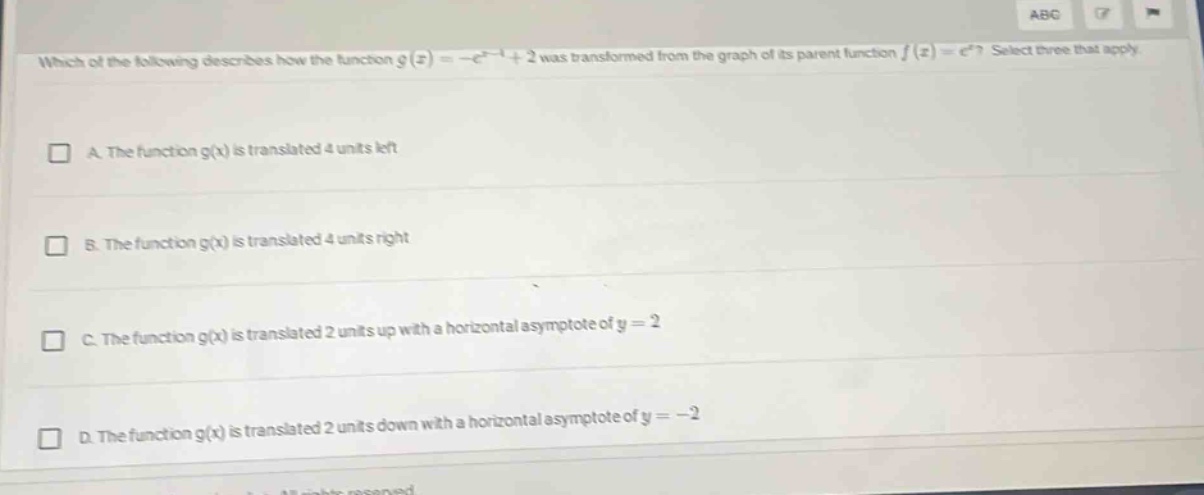
which of the following describes how the function g(x)=-e^(x - 1)+2 was transformed from the graph of its parent function f(x)=e^x? select three that apply. a. the function g(x) is translated 4 units left b. the function g(x) is translated 4 units right c. the function g(x) is translated 2 units up with a horizontal asymptote of y = 2 d. the function g(x) is translated 2 units down with a horizontal asymptote of y=-2
Answer
Explanation:
Step1: Analyze horizontal translation
For the general form of an exponential - function transformation $y = a\cdot f(x - h)+k$, comparing $g(x)=-e^{x - 1}+2$ with the parent function $f(x)=e^{x}$, the value of $h = 1$. A positive value of $h$ in $y = f(x - h)$ means a right - shift. So, there is no 4 - unit left or right shift.
Step2: Analyze vertical translation and horizontal asymptote
The general form of a transformed function is $y=a\cdot f(x - h)+k$. In the function $g(x)=-e^{x - 1}+2$, the value of $k = 2$. For the parent function $y = e^{x}$, the horizontal asymptote is $y = 0$. When we transform the function to $g(x)=-e^{x - 1}+2$, the graph is shifted 2 units up and the horizontal asymptote becomes $y = 2$.
Answer:
C. The function g(x) is translated 2 units up with a horizontal asymptote of y = 2