which of the following describes the transformations of ( g(x)=-(2)^{x + 4}-2 ) from the parent function (…
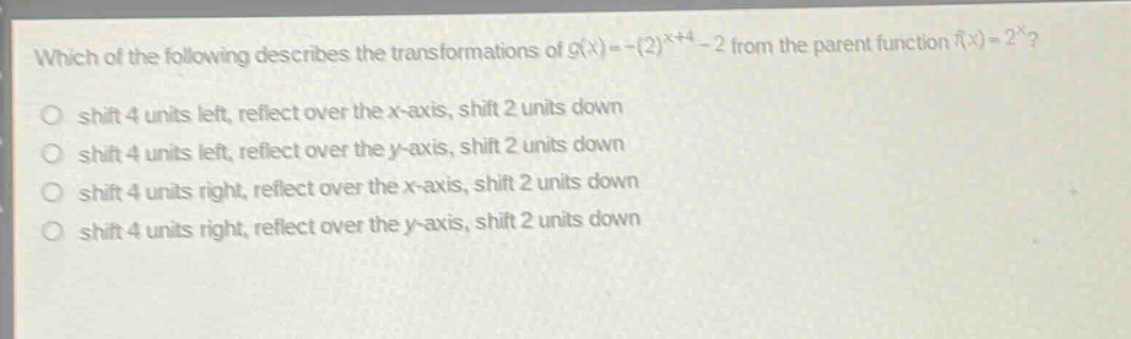
which of the following describes the transformations of ( g(x)=-(2)^{x + 4}-2 ) from the parent function ( f(x)=2^{x} )?\nshift 4 units left, reflect over the ( x )-axis, shift 2 units down\nshift 4 units left, reflect over the ( y )-axis, shift 2 units down\nshift 4 units right, reflect over the ( x )-axis, shift 2 units down\nshift 4 units right, reflect over the ( y )-axis, shift 2 units down
Answer
Explanation:
Step1: Analyze horizontal shift
For a function (y = f(x + h)), if (h>0), the graph of (y = f(x)) is shifted (h) units to the left. For (g(x)=-(2)^{x + 4}-2) compared to (f(x)=2^{x}), since (h = 4) in the form (y=-(2)^{(x+4)}-2), the graph is shifted (4) units to the left.
Step2: Analyze reflection
For a function (y=-f(x)), the graph of (y = f(x)) is reflected over the (x) - axis. Since (g(x)=-(2)^{x + 4}-2), and the parent function is (f(x)=2^{x}), there is a reflection over the (x) - axis.
Step3: Analyze vertical shift
For a function (y=f(x)-k), if (k > 0), the graph of (y = f(x)) is shifted (k) units down. Since (g(x)=-(2)^{x + 4}-2) (where (k = 2)), the graph is shifted (2) units down.
Answer:
shift 4 units left, reflect over the (x) - axis, shift 2 units down