which of the following is the equation of the function below?\ny = 2csc2(x+pi) - 2\ny = 0.5sec2(x+pi) - 4\ny…
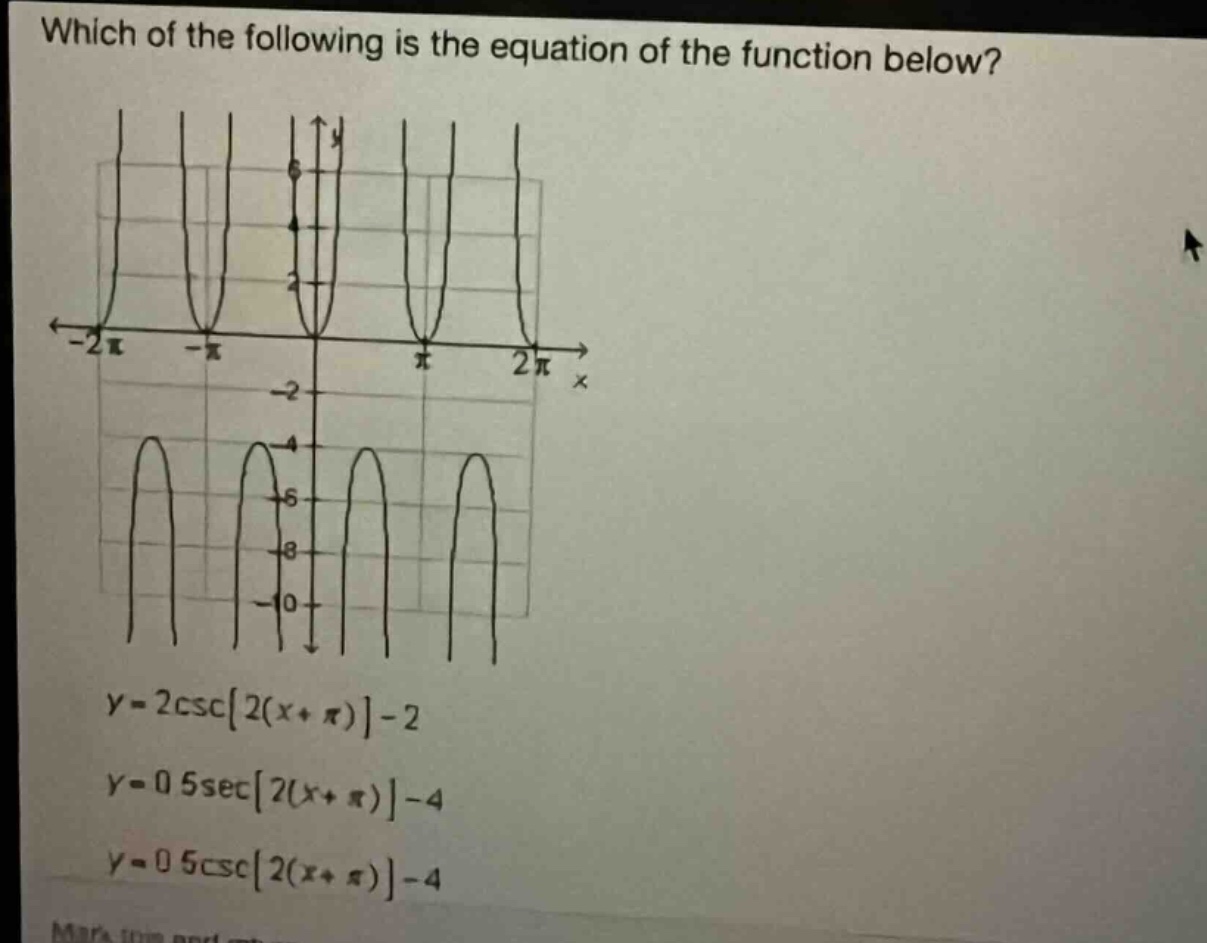
which of the following is the equation of the function below?\ny = 2csc2(x+pi) - 2\ny = 0.5sec2(x+pi) - 4\ny = 0.5csc2(x+pi) - 4
Answer
Explanation:
Step1: Recall properties of trig - functions
The general form of a cosecant or secant function is (y = A\csc(B(x - C))+D) or (y = A\sec(B(x - C))+D), where (|A|) is the amplitude (for secant and cosecant, it affects the vertical stretch), (B) affects the period ((T=\frac{2\pi}{|B|})), (C) is the phase - shift, and (D) is the vertical shift.
Step2: Analyze the period
The period of the given function is (\pi). For a cosecant or secant function (y = A\csc(B(x - C))+D) or (y = A\sec(B(x - C))+D), the period (T=\frac{2\pi}{|B|}). If (T = \pi), then (\frac{2\pi}{|B|}=\pi), so (|B| = 2).
Step3: Analyze the vertical shift
The mid - line of the function is (y=-4), so (D=-4).
Step4: Analyze the vertical stretch
The function has a vertical stretch factor. Looking at the options, we consider the coefficient (A).
Step5: Analyze the phase - shift
The function has a phase - shift. The form (y = A\csc(B(x +\pi))+D) or (y = A\sec(B(x+\pi))+D) indicates a phase - shift of (-\pi). The function appears to be a cosecant function. Comparing with the general form (y = A\csc(B(x - C))+D), with (B = 2), (D=-4) and (A = 0.5), the equation of the function is (y=0.5\csc[2(x+\pi)] - 4).
Answer:
(y = 0.5\csc[2(x+\pi)]-4)