which of the following is an equation for the graph? a. 2 sin(2x + $\frac{pi}{2}$) + 2 b. sin(2x + $pi$) + 2…
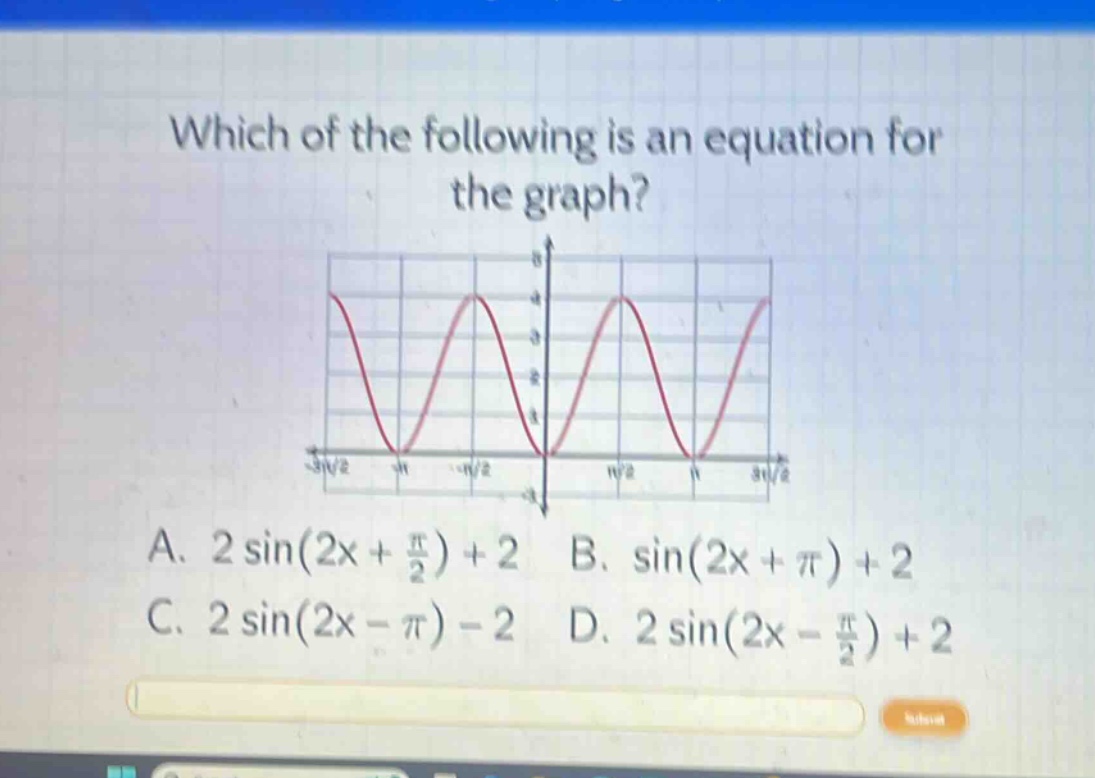
which of the following is an equation for the graph? a. 2 sin(2x + $\frac{pi}{2}$) + 2 b. sin(2x + $pi$) + 2 c. 2 sin(2x - $pi$) - 2 d. 2 sin(2x - $\frac{pi}{2}$) + 2
Answer
Answer:
A. $2\sin(2x+\frac{\pi}{2}) + 2$
Explanation:
Step1: Analyze amplitude
The amplitude of a sine - function $y = A\sin(Bx - C)+D$ is $|A|$. The graph has a maximum value of 4 and a minimum value of 0. The amplitude $A=\frac{4 - 0}{2}=2$. So we can rule out option B (since $A = 1$ in option B).
Step2: Analyze vertical shift
The mid - line of the graph is $y = 2$. For a sine function $y=A\sin(Bx - C)+D$, the vertical shift is $D$. Here $D = 2$, so we can rule out option C (since $D=-2$ in option C).
Step3: Analyze phase shift
The general form of a sine function is $y = A\sin(Bx - C)+D$. The period of the sine function is $T=\frac{2\pi}{B}$. Here, the period of the given graph is $\pi$, and since $T=\frac{2\pi}{B}=\pi$, then $B = 2$. For the phase - shift, we know that the standard sine function $y=\sin x$ has a maximum at $x=\frac{\pi}{2}$. The given function has a maximum at $x = 0$. For the function $y = A\sin(Bx - C)+D$, when $B = 2$, if we set $2x - C=\frac{\pi}{2}$ and $x = 0$, then $-C=\frac{\pi}{2}$ or $C=-\frac{\pi}{2}$, and the function is $y = 2\sin(2x+\frac{\pi}{2})+2$. So option A is correct.