which of the following is equivalent to ∫₁ᵉ⁶ 1 / (x(2 + ln x)) dx?\na ∫₂⁸ 1 / u du\nb ∫₁ᵉ⁶ 1 / u du\nc 1 /…
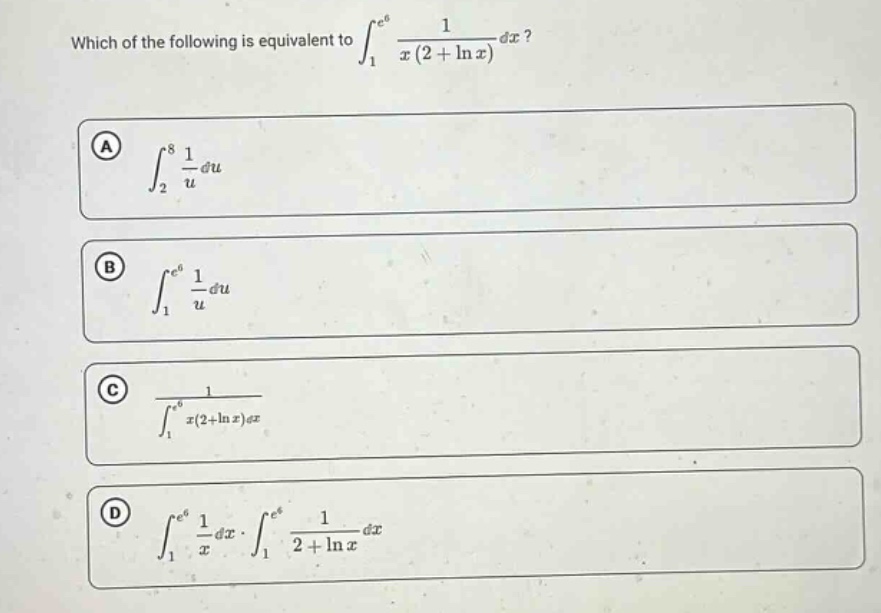
which of the following is equivalent to ∫₁ᵉ⁶ 1 / (x(2 + ln x)) dx?\na ∫₂⁸ 1 / u du\nb ∫₁ᵉ⁶ 1 / u du\nc 1 / ∫₁ᵉ⁶ x(2+ln x)dx\nd ∫₁ᵉ⁶ 1 / x dx · ∫₁ᵉ⁶ 1 / (2 + ln x) dx
Answer
Explanation:
Step1: Use substitution
Let $u = 2+\ln x$. Then $du=\frac{1}{x}dx$.
Step2: Find new - limits of integration
When $x = 1$, $u=2+\ln(1)=2$. When $x = e^{6}$, $u=2+\ln(e^{6})=2 + 6=8$.
Step3: Rewrite the integral
The integral $\int_{1}^{e^{6}}\frac{1}{x(2+\ln x)}dx=\int_{2}^{8}\frac{1}{u}du$.
Answer:
A. $\int_{2}^{8}\frac{1}{u}du$