which of the following explains why ( f(x)=log _{4} x ) does not have a ( y )-intercept? check all that…
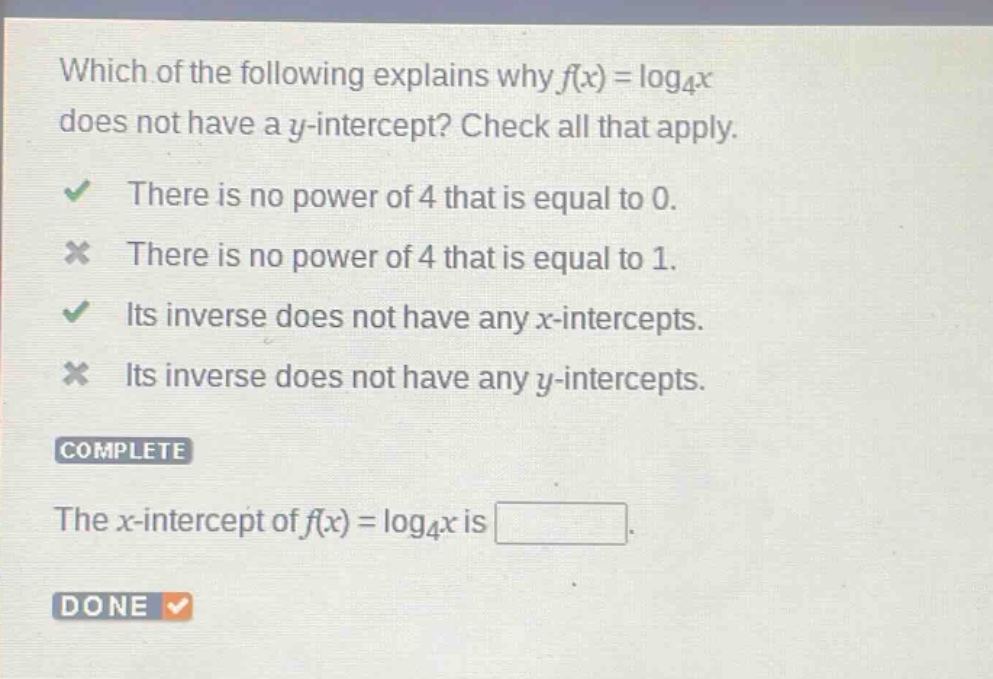
which of the following explains why ( f(x)=log _{4} x ) does not have a ( y )-intercept? check all that apply. there is no power of 4 that is equal to 0. there is no power of 4 that is equal to 1. its inverse does not have any ( x )-intercepts. its inverse does not have any ( y )-intercepts. complete the ( x )-intercept of ( f(x)=log _{4} x ) is
Answer
Explanation:
Step1: Recall the definition of (x)-intercept
The (x)-intercept of a function (y = f(x)) is the value of (x) when (y = 0). For the function (y=\log_{4}x), we set (y = 0).
Step2: Solve the equation (\log_{4}x=0)
By the definition of logarithms, if (\log_{a}b = c), then (b=a^{c}). So, if (\log_{4}x = 0), then (x = 4^{0}).
Step3: Calculate (4^{0})
Using the rule (a^{0}=1) ((a\neq0)), we have (4^{0}=1).
Answer:
(1)