which of the following have a frequency factor of b = 1?\n□ a sine function whose period is 2π radians\n□ a…
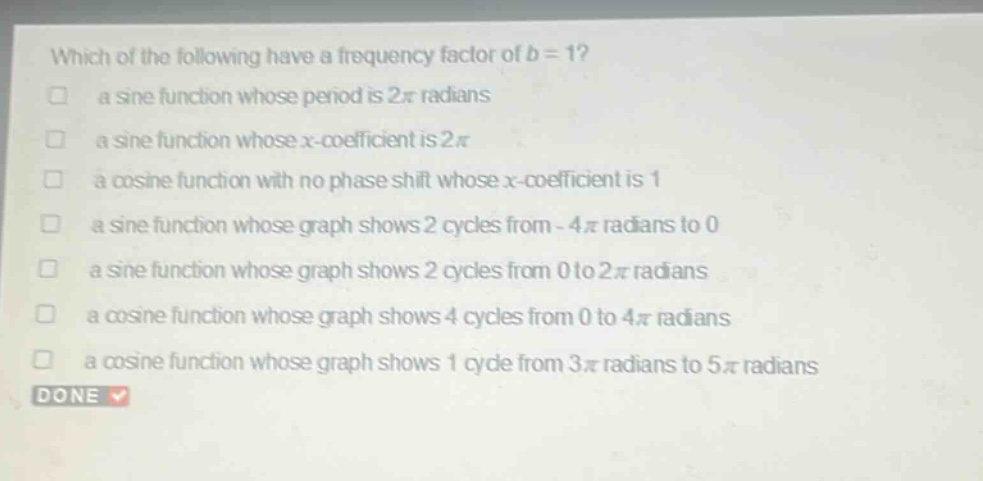
which of the following have a frequency factor of b = 1?\n□ a sine function whose period is 2π radians\n□ a sine function whose x - coefficient is 2π\n□ a cosine function with no phase shift whose x - coefficient is 1\n□ a sine function whose graph shows 2 cycles from - 4π radians to 0\n□ a sine function whose graph shows 2 cycles from 0 to 2π radians\n□ a cosine function whose graph shows 4 cycles from 0 to 4π radians\n□ a cosine function whose graph shows 1 cycle from 3π radians to 5π radians\ndone
Answer
Answer:
- a sine function whose period is $2\pi$ radians
- a cosine function with no phase - shift whose $x$-coefficient is 1
- a cosine function whose graph shows 1 cycle from $3\pi$ radians to $5\pi$ radians
Explanation:
Step1: Recall the period formula
The period formula for a trigonometric function $y = A\sin(bx - c)+d$ or $y=A\cos(bx - c)+d$ is $T=\frac{2\pi}{|b|}$, where $T$ is the period and $b$ is the frequency factor. When $b = 1$, $T = 2\pi$.
Step2: Analyze each option
Option 1:
A sine function whose period is $2\pi$ radians. Using $T=\frac{2\pi}{|b|}$, if $T = 2\pi$, then $2\pi=\frac{2\pi}{|b|}$, solving for $b$ gives $|b| = 1$, so it can have $b = 1$.
Option 2:
A sine function whose $x$-coefficient is $2\pi$. Here $b = 2\pi\neq1$.
Option 3:
A cosine function with no phase - shift whose $x$-coefficient is 1. For $y = A\cos(bx)+d$ with $b = 1$, it meets the requirement.
Option 4:
A sine function whose graph shows 2 cycles from $- 4\pi$ to 0. The period $T=\frac{0-(-4\pi)}{2}=2\pi$. Using $T=\frac{2\pi}{|b|}$, we get $|b| = 1$, so it can have $b = 1$.
Option 5:
A sine function whose graph shows 2 cycles from 0 to $2\pi$. The period $T=\frac{2\pi - 0}{2}=\pi$. Using $T=\frac{2\pi}{|b|}$, we get $\pi=\frac{2\pi}{|b|}$, so $|b| = 2\neq1$.
Option 6:
A cosine function whose graph shows 4 cycles from 0 to $4\pi$. The period $T=\frac{4\pi-0}{4}=\pi$. Using $T=\frac{2\pi}{|b|}$, we get $\pi=\frac{2\pi}{|b|}$, so $|b| = 2\neq1$.
Option 7:
A cosine function whose graph shows 1 cycle from $3\pi$ to $5\pi$. The period $T=5\pi - 3\pi=2\pi$. Using $T=\frac{2\pi}{|b|}$, we get $|b| = 1$, so it can have $b = 1$.