the following function models the maximum weight, w, that a person can bench press in pounds at the end of t…
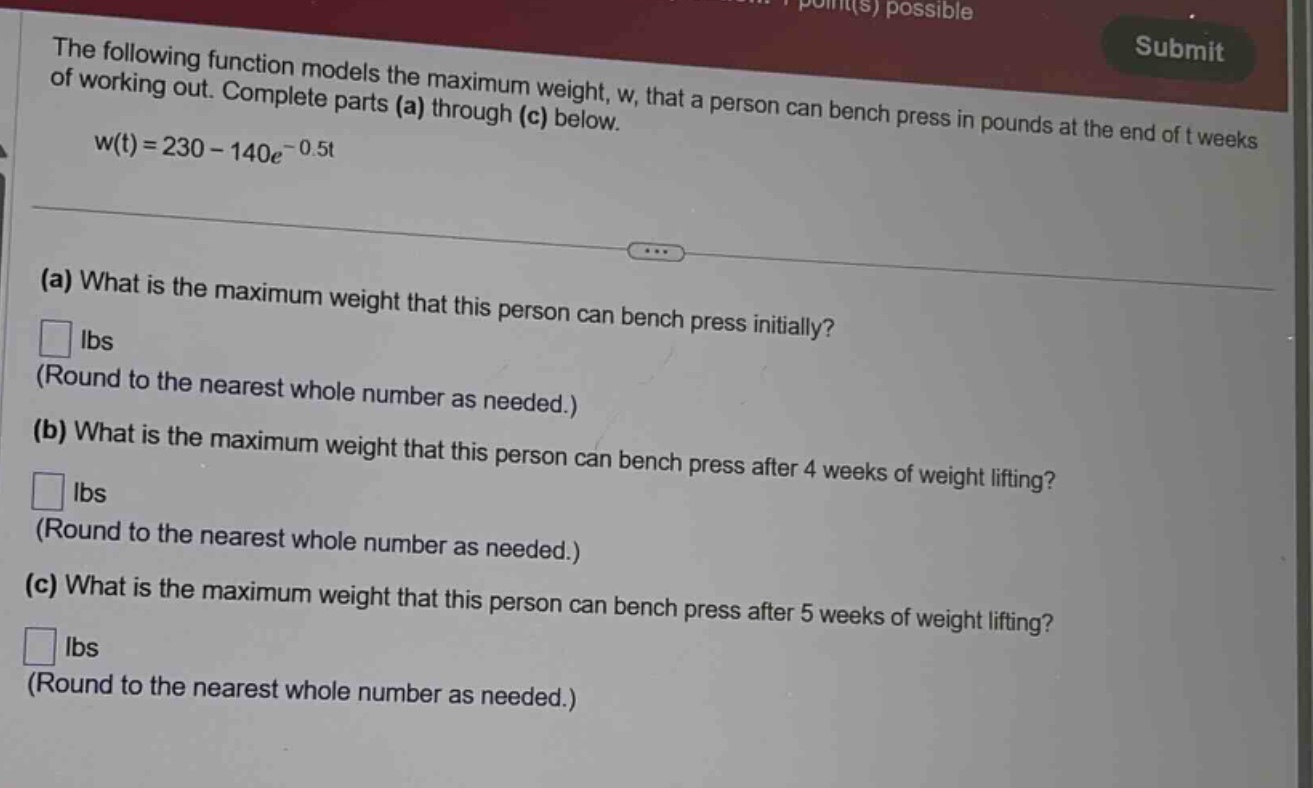
the following function models the maximum weight, w, that a person can bench press in pounds at the end of t weeks of working out. complete parts (a) through (c) below. w(t)=230 - 140e^(-0.5t) (a) what is the maximum weight that this person can bench press initially? lbs (round to the nearest whole number as needed.) (b) what is the maximum weight that this person can bench press after 4 weeks of weight lifting? lbs (round to the nearest whole number as needed.) (c) what is the maximum weight that this person can bench press after 5 weeks of weight lifting? lbs (round to the nearest whole number as needed.)
Answer
Explanation:
Step1: Find initial weight (t = 0)
Substitute (t = 0) into (w(t)=230 - 140e^{-0.5t}). Since (e^{-0.5\times0}=e^{0}=1), then (w(0)=230-140\times1=230 - 140=90).
Step2: Find weight after 4 weeks (t = 4)
Substitute (t = 4) into (w(t)): (w(4)=230-140e^{-0.5\times4}=230 - 140e^{-2}). We know that (e^{-2}\approx0.13534), so (w(4)=230-140\times0.13534=230 - 18.9476\approx211).
Step3: Find weight after 5 weeks (t = 5)
Substitute (t = 5) into (w(t)): (w(5)=230-140e^{-0.5\times5}=230 - 140e^{-2.5}). Since (e^{-2.5}\approx0.082085), then (w(5)=230-140\times0.082085=230 - 11.4919\approx219).
Answer:
(a) 90 lbs (b) 211 lbs (c) 219 lbs