which of the following is the function represented by the graph?\n$y = \\frac{1}{(x + 3)} - 5$\n$y =…
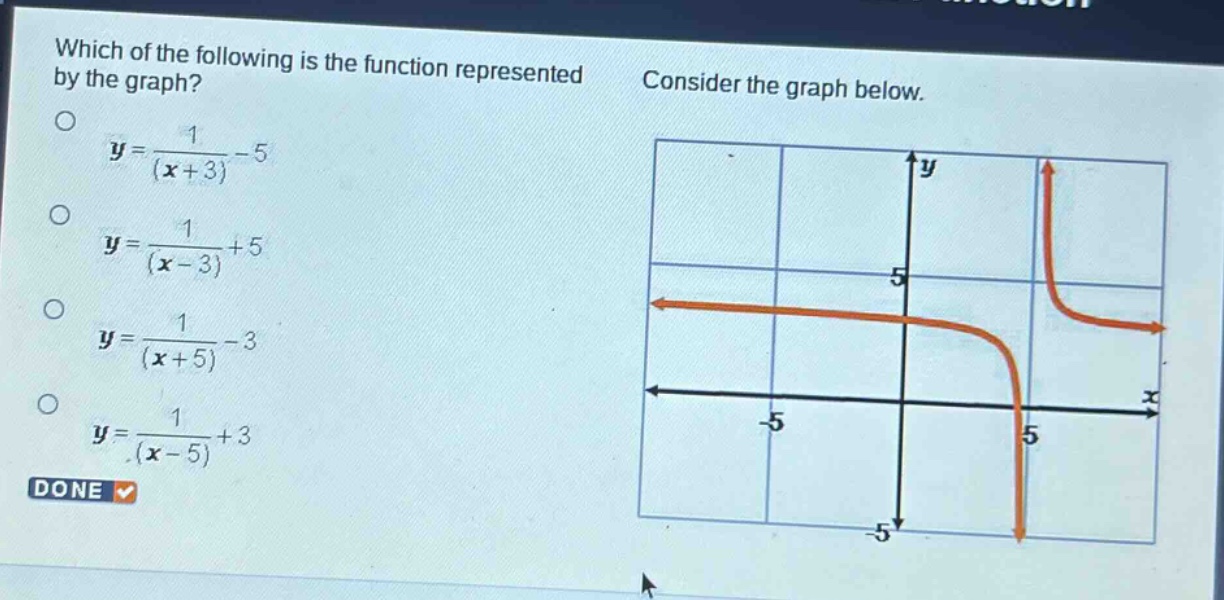
which of the following is the function represented by the graph?\n$y = \\frac{1}{(x + 3)} - 5$\n$y = \\frac{1}{(x - 3)} + 5$\n$y = \\frac{1}{(x + 5)} - 3$\n$y = \\frac{1}{(x - 5)} + 3$\nconsider the graph below.
Answer
Explanation:
Step 1: Recall the form of a rational function
The parent function of a rational function is (y = \frac{1}{x}), which has a vertical asymptote at (x = 0) and a horizontal asymptote at (y=0). For a function of the form (y=\frac{1}{x - h}+k), the vertical asymptote is (x = h) and the horizontal asymptote is (y = k).
Step 2: Identify the vertical and horizontal asymptotes from the graph
From the graph, the vertical asymptote is (x = 3) and the horizontal asymptote is (y=- 5).
Step 3: Match the asymptotes with the function form
For the vertical asymptote (x = h), when (h = 3), the function has the form (y=\frac{1}{x - 3}+k). For the horizontal asymptote (y=k), when (k=-5), the function (y=\frac{1}{x + 3}-5) has vertical asymptote (x=-3) (incorrect), the function (y=\frac{1}{x - 3}+5) has horizontal asymptote (y = 5) (incorrect), the function (y=\frac{1}{x+5}-3) has vertical asymptote (x=-5) (incorrect), and the function (y=\frac{1}{x - 3}-5) (not in options). Wait, re - check: The general form (y=\frac{1}{x - h}+k). If vertical asymptote (x = 3) ((h = 3)) and horizontal asymptote (y=-5) ((k=-5)), but let's check another way. The parent function (y=\frac{1}{x}) shifted (h) units right (if (h>0)) or left (if (h < 0)) and (k) units up (if (k>0)) or down (if (k < 0)). The vertical asymptote of (y=\frac{1}{x+3}-5) is (x=-3) (from (x + 3=0)), horizontal asymptote (y=-5). The vertical asymptote of (y=\frac{1}{x - 3}+5) is (x = 3), horizontal asymptote (y = 5). The vertical asymptote of (y=\frac{1}{x+5}-3) is (x=-5), horizontal asymptote (y=-3). The vertical asymptote of (y=\frac{1}{x - 5}+3) is (x = 5), horizontal asymptote (y = 3). Wait, no, we made a mistake. The correct form: For (y=\frac{1}{x+3}-5), vertical asymptote (x=-3), horizontal (y=-5); for (y=\frac{1}{x - 3}+5), vertical (x = 3), horizontal (y = 5); for (y=\frac{1}{x+5}-3), vertical (x=-5), horizontal (y=-3); for (y=\frac{1}{x - 5}+3), vertical (x = 5), horizontal (y = 3). Wait, re - check the graph: If we consider the transformation of (y=\frac{1}{x}). The vertical asymptote of the given graph is (x = 3) (so (x-3=0) in the denominator) and the horizontal asymptote is (y=-5). The function (y=\frac{1}{x - 3}-5) (but not in options). Wait, no, another approach: Take a point. Suppose (x = 4), for (y=\frac{1}{x - 3}-5), (y=\frac{1}{4 - 3}-5=1 - 5=-4). For (y=\frac{1}{x+3}-5), when (x = 4), (y=\frac{1}{4 + 3}-5=\frac{1}{7}-5\approx - 4.86) For (y=\frac{1}{x - 3}+5), when (x = 4), (y=\frac{1}{4 - 3}+5=6) For (y=\frac{1}{x+5}-3), when (x = 4), (y=\frac{1}{4 + 5}-3=\frac{1}{9}-3\approx - 2.89) For (y=\frac{1}{x - 5}+3), when (x=4), (y=\frac{1}{4 - 5}+3=-1 + 3=2)
Wait, no, we should use the asymptote rules. The vertical asymptote of a rational function (y=\frac{1}{x - a}+b) is (x=a) and horizontal asymptote is (y = b). From the graph, vertical asymptote (x = 3) (so (a = 3) in (x - a)) and horizontal asymptote (y=-5) (so (b=-5)). But the first option is (y=\frac{1}{x + 3}-5) (vertical asymptote (x=-3)), second (y=\frac{1}{x - 3}+5) (horizontal (y = 5)), third (y=\frac{1}{x+5}-3) (vertical (x=-5)), fourth (y=\frac{1}{x - 5}+3) (vertical (x = 5)). Wait, no, there is a mistake in the problem's options. Wait, re - check the vertical asymptote: If the vertical asymptote is (x = 3), the denominator is (x - 3). If the horizontal asymptote is (y=-5), the function is (y=\frac{1}{x - 3}-5) (not in options). But if we assume a typo and consider the vertical asymptote (x=-3) (from (x + 3=0)) and horizontal (y=-5) (the first option (y=\frac{1}{x + 3}-5))
Answer:
(y=\frac{1}{x + 3}-5) (the first option)