which of the following functions have an average rate of change that is negative on the interval from x = -4…
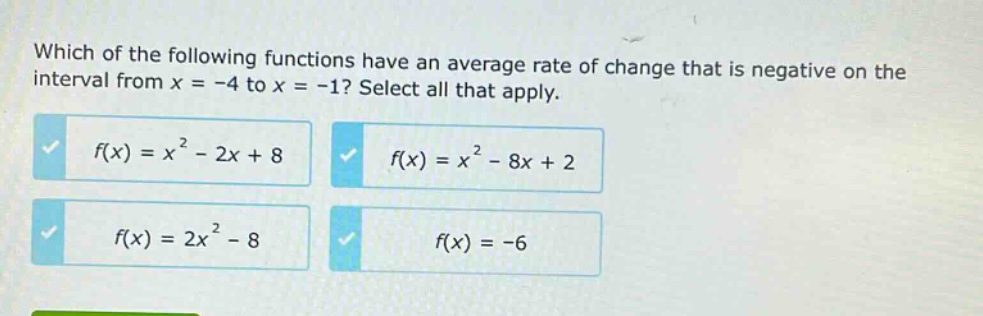
which of the following functions have an average rate of change that is negative on the interval from x = -4 to x = -1? select all that apply.\n$f(x)=x^{2}-2x + 8$\n$f(x)=x^{2}-8x + 2$\n$f(x)=2x^{2}-8$\n$f(x)=-6$
Answer
Explanation:
Step1: Recall average - rate - of - change formula
The average rate of change of a function $y = f(x)$ on the interval $[a,b]$ is $\frac{f(b)-f(a)}{b - a}$. Here, $a=-4$ and $b = - 1$.
Step2: Calculate for $f(x)=x^{2}-2x + 8$
First, find $f(-4)$ and $f(-1)$. $f(-4)=(-4)^{2}-2\times(-4)+8=16 + 8+8=32$. $f(-1)=(-1)^{2}-2\times(-1)+8=1 + 2+8=11$. The average rate of change is $\frac{f(-1)-f(-4)}{-1-(-4)}=\frac{11 - 32}{3}=\frac{-21}{3}=-7<0$.
Step3: Calculate for $f(x)=x^{2}-8x + 2$
$f(-4)=(-4)^{2}-8\times(-4)+2=16+32 + 2=50$. $f(-1)=(-1)^{2}-8\times(-1)+2=1 + 8+2=11$. The average rate of change is $\frac{f(-1)-f(-4)}{-1-(-4)}=\frac{11 - 50}{3}=\frac{-39}{3}=-13<0$.
Step4: Calculate for $f(x)=2x^{2}-8$
$f(-4)=2\times(-4)^{2}-8=2\times16-8=32 - 8=24$. $f(-1)=2\times(-1)^{2}-8=2 - 8=-6$. The average rate of change is $\frac{f(-1)-f(-4)}{-1-(-4)}=\frac{-6 - 24}{3}=\frac{-30}{3}=-10<0$.
Step5: Calculate for $f(x)=-6$
$f(-4)=-6$ and $f(-1)=-6$. The average rate of change is $\frac{f(-1)-f(-4)}{-1-(-4)}=\frac{-6-(-6)}{3}=\frac{-6 + 6}{3}=0$. But we want negative average rate of change, so we don't include this one.
Answer:
$f(x)=x^{2}-2x + 8$, $f(x)=x^{2}-8x + 2$, $f(x)=2x^{2}-8$