which of the following functions is continuous at x = 3? a f(x)={ (x^2+x - 12)/(x - 3) for x≠3; 8 for x = 3…
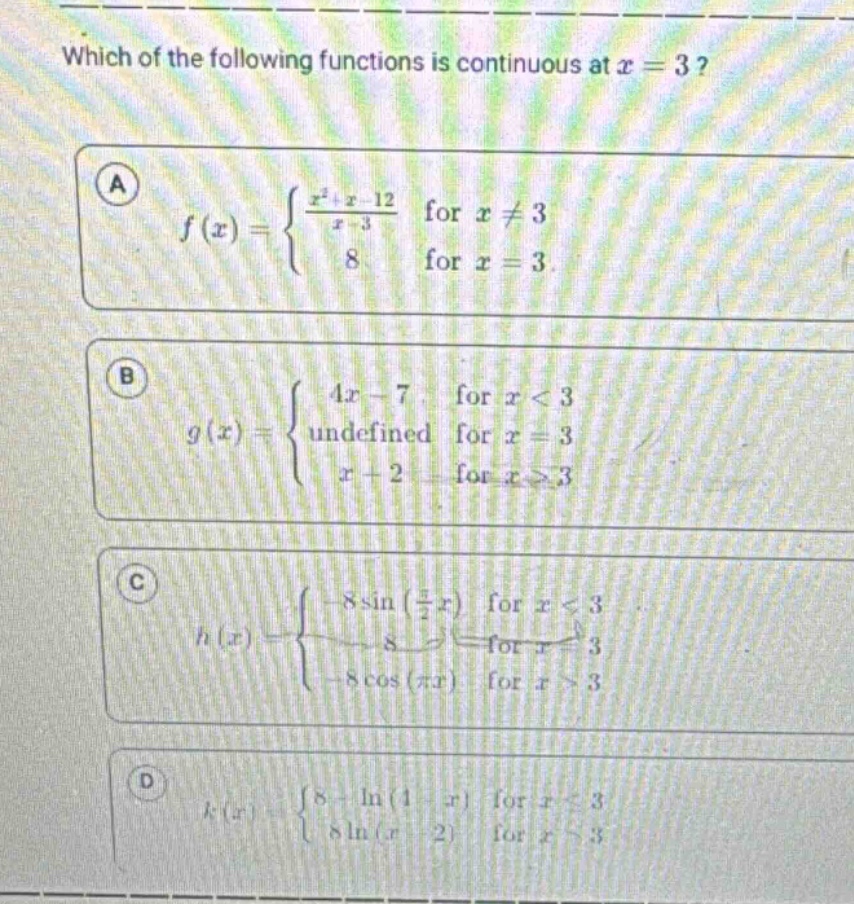
which of the following functions is continuous at x = 3? a f(x)={ (x^2+x - 12)/(x - 3) for x≠3; 8 for x = 3 } b g(x)={ 4x - 7 for x<3; undefined for x = 3; x + 2 for x≥3 } c h(x)={ - 8sin((π/2)x) for x<3; 8 for x = 3; - 8cos(πx) for x>3 } d k(x)={ 8+ln(1 - x) for x≤3; 8ln(x - 2) for x>3 }
Answer
Explanation:
Step1: Recall continuity condition
A function $y = f(x)$ is continuous at $x = a$ if $\lim_{x\rightarrow a^{-}}f(x)=\lim_{x\rightarrow a^{+}}f(x)=f(a)$.
Step2: Analyze option A
First, simplify $\frac{x^{2}+x - 12}{x - 3}=\frac{(x + 4)(x - 3)}{x - 3}=x + 4$ for $x\neq3$. Then $\lim_{x\rightarrow3}\frac{x^{2}+x - 12}{x - 3}=\lim_{x\rightarrow3}(x + 4)=7$, and $f(3)=8$. Since $\lim_{x\rightarrow3}f(x)\neq f(3)$, $f(x)$ is not continuous at $x = 3$.
Step3: Analyze option B
$\lim_{x\rightarrow3^{-}}g(x)=\lim_{x\rightarrow3^{-}}(4x - 7)=4\times3-7 = 5$, $\lim_{x\rightarrow3^{+}}g(x)=\lim_{x\rightarrow3^{+}}(x + 2)=3 + 2=5$, but $g(3)$ is undefined. So $g(x)$ is not continuous at $x = 3$.
Step4: Analyze option C
$\lim_{x\rightarrow3^{-}}h(x)=\lim_{x\rightarrow3^{-}}(- 8\sin(\frac{\pi}{2}x))=-8\sin(\frac{3\pi}{2})=8$, $h(3)=8$, $\lim_{x\rightarrow3^{+}}h(x)=\lim_{x\rightarrow3^{+}}(-8\cos(\pi x))=-8\cos(3\pi)=8$. Since $\lim_{x\rightarrow3^{-}}h(x)=\lim_{x\rightarrow3^{+}}h(x)=h(3) = 8$, $h(x)$ is continuous at $x = 3$.
Step5: Analyze option D
$\lim_{x\rightarrow3^{-}}k(x)=\lim_{x\rightarrow3^{-}}(8+\ln(4 - x))$, as $x\rightarrow3^{-}$, $\ln(4 - x)\rightarrow\ln(1)=0$, so $\lim_{x\rightarrow3^{-}}k(x)=8$. $\lim_{x\rightarrow3^{+}}k(x)=\lim_{x\rightarrow3^{+}}(8\ln(x - 2))=8\ln(1)=0$. Since $\lim_{x\rightarrow3^{-}}k(x)\neq\lim_{x\rightarrow3^{+}}k(x)$, $k(x)$ is not continuous at $x = 3$.
Answer:
C. $h(x)=\begin{cases}-8\sin(\frac{\pi}{2}x)&\text{for }x < 3\8&\text{for }x = 3\-8\cos(\pi x)&\text{for }x>3\end{cases}$