which of the following functions is/are discontinuous? choose all that apply.\nlinear\n$f(x)=x$\nabsolute…
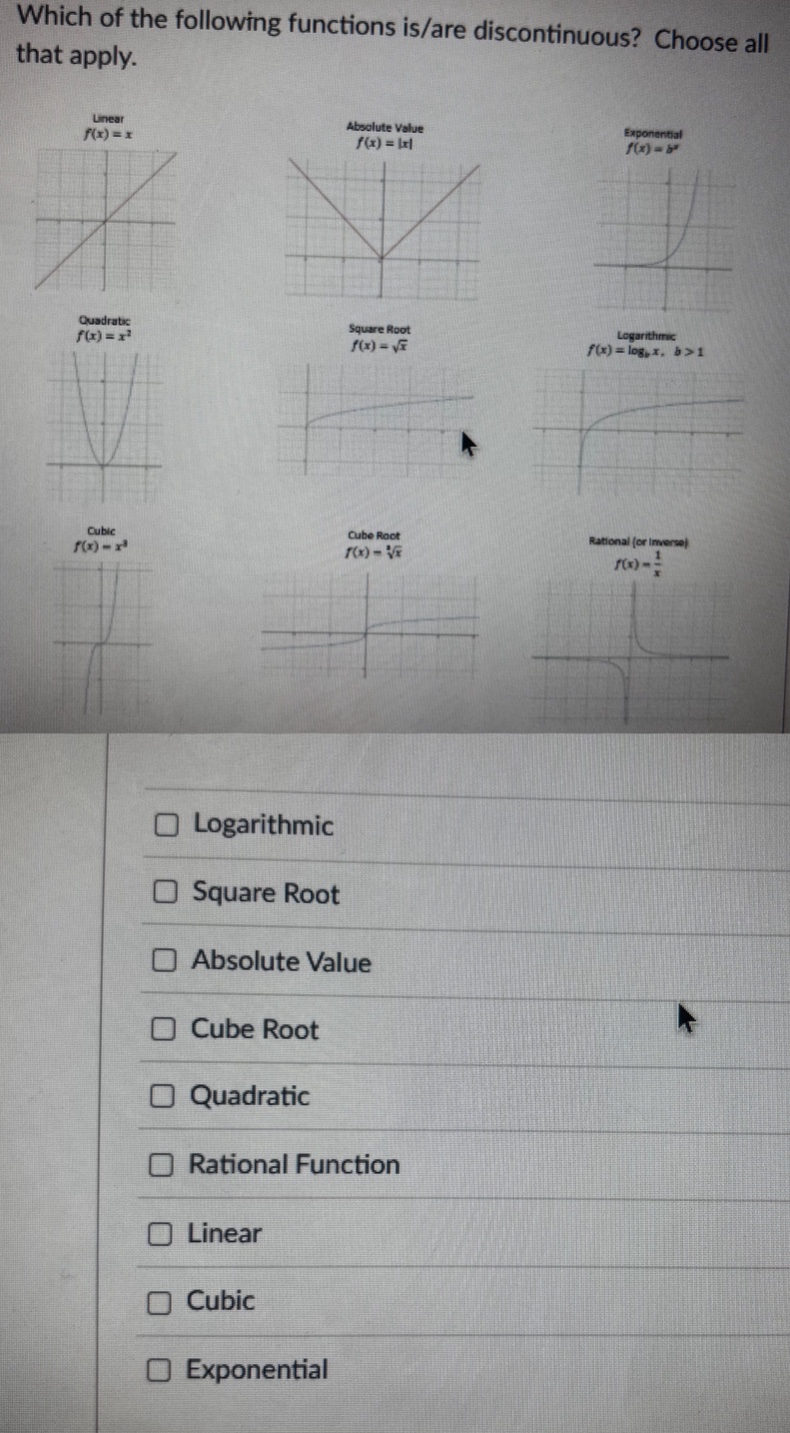
which of the following functions is/are discontinuous? choose all that apply.\nlinear\n$f(x)=x$\nabsolute value\n$f(x)=|x|$\nexponential\n$f(x)=b^{x}$\nquadratic\n$f(x)=x^{2}$\nsquare root\n$f(x)=sqrt{x}$\nlogarithmic\n$f(x)=log_{b}x,b > 1$\ncubic\n$f(x)=x^{3}$\ncube root\n$f(x)=sqrt3{x}$\nrational (or inverse)\n$f(x)=\frac{1}{x}$\nlogarithmic\nsquare root\nabsolute value\ncube root\nquadratic\nrational function\nlinear\ncubic\nexponential
Answer
Explanation:
Step1: Recall continuity definition
A function is continuous at a point if the limit as $x$ approaches that point exists and is equal to the function - value at that point.
Step2: Analyze linear function $f(x)=x$
The linear function $y = x$ is a straight - line. For any real number $a$, $\lim_{x\rightarrow a}x=a$ and $f(a)=a$. It is continuous everywhere.
Step3: Analyze absolute - value function $f(x)=\vert x\vert$
The absolute - value function $y = \vert x\vert=\begin{cases}x, & x\geq0\-x, & x < 0\end{cases}$. For any real number $a$, $\lim_{x\rightarrow a}\vert x\vert=\vert a\vert$. It is continuous everywhere.
Step4: Analyze quadratic function $f(x)=x^{2}$
The quadratic function $y = x^{2}$ is a polynomial. Polynomials are continuous everywhere. For any real number $a$, $\lim_{x\rightarrow a}x^{2}=a^{2}$ and $f(a)=a^{2}$.
Step5: Analyze square - root function $f(x)=\sqrt{x}$
The domain of $y = \sqrt{x}$ is $x\geq0$. It is continuous on its domain $[0,+\infty)$. For any $a\geq0$, $\lim_{x\rightarrow a}\sqrt{x}=\sqrt{a}$ (using the right - hand limit when $a = 0$).
Step6: Analyze exponential function $f(x)=b^{x},b>0,b\neq1$
Exponential functions are continuous everywhere. For any real number $a$, $\lim_{x\rightarrow a}b^{x}=b^{a}$.
Step7: Analyze logarithmic function $f(x)=\log_{b}x,b > 1$
The domain of $y=\log_{b}x$ is $(0,+\infty)$. It is continuous on its domain. For any $a>0$, $\lim_{x\rightarrow a}\log_{b}x=\log_{b}a$.
Step8: Analyze cubic function $f(x)=x^{3}$
Cubic functions are polynomials. Polynomials are continuous everywhere. For any real number $a$, $\lim_{x\rightarrow a}x^{3}=a^{3}$ and $f(a)=a^{3}$.
Step9: Analyze cube - root function $f(x)=\sqrt[3]{x}$
The cube - root function $y=\sqrt[3]{x}$ has a domain of all real numbers. For any real number $a$, $\lim_{x\rightarrow a}\sqrt[3]{x}=\sqrt[3]{a}$. It is continuous everywhere.
Step10: Analyze rational function $f(x)=\frac{1}{x}$
The rational function $y=\frac{1}{x}$ has a domain of all real numbers except $x = 0$. At $x = 0$, $\lim_{x\rightarrow0^{+}}\frac{1}{x}=+\infty$ and $\lim_{x\rightarrow0^{-}}\frac{1}{x}=-\infty$. The limit as $x\rightarrow0$ does not exist. So, it is discontinuous at $x = 0$.
Answer:
Rational Function