3 for each of the following functions:\n i find and classify all turning points.\n ii find and classify all…
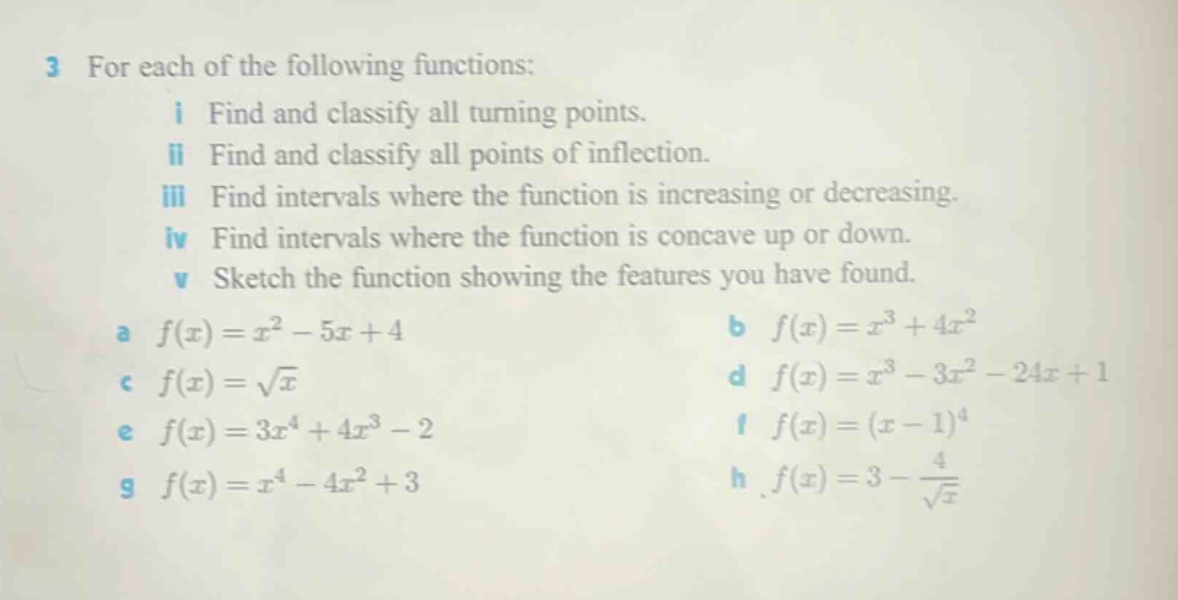
3 for each of the following functions:\n i find and classify all turning points.\n ii find and classify all points of inflection.\n iii find intervals where the function is increasing or decreasing.\n iv find intervals where the function is concave up or down.\n v sketch the function showing the features you have found.\n a $f(x)=x^{2}-5x + 4$\n b $f(x)=x^{3}+4x^{2}$\n c $f(x)=sqrt{x}$\n d $f(x)=x^{3}-3x^{2}-24x + 1$\n e $f(x)=3x^{4}+4x^{3}-2$\n f $f(x)=(x - 1)^{4}$\n g $f(x)=x^{4}-4x^{2}+3$\n h $f(x)=3-\frac{4}{sqrt{x}}$
Answer
For function $f(x)=x^{2}-5x + 4$
Explanation:
Step1: Find the first - derivative
The derivative of $f(x)=x^{2}-5x + 4$ using the power rule $\frac{d}{dx}(x^{n})=nx^{n - 1}$ is $f^\prime(x)=2x-5$.
Step2: Find turning points
Set $f^\prime(x)=0$, so $2x - 5=0$. Solving for $x$ gives $x=\frac{5}{2}$. Substitute $x = \frac{5}{2}$ into $f(x)$: $f(\frac{5}{2})=(\frac{5}{2})^{2}-5\times\frac{5}{2}+4=\frac{25}{4}-\frac{25}{2}+4=\frac{25 - 50 + 16}{4}=-\frac{9}{4}$. The second - derivative $f^{\prime\prime}(x) = 2>0$, so the turning point $(\frac{5}{2},-\frac{9}{4})$ is a minimum.
Step3: Find the second - derivative
$f^{\prime\prime}(x)=2$. Since $f^{\prime\prime}(x)$ is a non - zero constant, there are no points of inflection.
Step4: Find intervals of increase and decrease
$f^\prime(x)=2x - 5$. When $f^\prime(x)>0$, $2x-5>0$, $x>\frac{5}{2}$, so the function is increasing on the interval $(\frac{5}{2},\infty)$. When $f^\prime(x)<0$, $2x - 5<0$, $x<\frac{5}{2}$, so the function is decreasing on the interval $(-\infty,\frac{5}{2})$.
Step5: Find intervals of concavity
Since $f^{\prime\prime}(x)=2>0$, the function is concave up on $(-\infty,\infty)$.
Step6: Sketch the function
The function is a parabola opening upwards (because $a = 1>0$ in $y=ax^{2}+bx + c$) with a minimum at $(\frac{5}{2},-\frac{9}{4})$, $y$ - intercept at $f(0)=4$, and $x$ - intercepts by setting $y = 0$: $x^{2}-5x + 4=(x - 1)(x - 4)=0$, so $x = 1$ and $x = 4$.
Answer:
- Turning point: $(\frac{5}{2},-\frac{9}{4})$, minimum.
- No points of inflection.
- Increasing on $(\frac{5}{2},\infty)$, decreasing on $(-\infty,\frac{5}{2})$.
- Concave up on $(-\infty,\infty)$.
- Sketch: Parabola opening upwards with $x$ - intercepts at $x = 1$ and $x = 4$, $y$ - intercept at $y = 4$ and minimum at $(\frac{5}{2},-\frac{9}{4})$.
We can follow a similar process for the other functions in the problem set. For example, for $f(x)=x^{3}+4x^{2}$:
Explanation:
Step1: Find the first - derivative
Using the power rule, $f^\prime(x)=3x^{2}+8x=x(3x + 8)$.
Step2: Find turning points
Set $f^\prime(x)=0$, then $x(3x + 8)=0$. So $x = 0$ or $x=-\frac{8}{3}$. $f(0)=0$ and $f(-\frac{8}{3})=(-\frac{8}{3})^{3}+4\times(-\frac{8}{3})^{2}=-\frac{512}{27}+\frac{256}{9}=\frac{-512 + 768}{27}=\frac{256}{27}$. The second - derivative $f^{\prime\prime}(x)=6x + 8$. $f^{\prime\prime}(0)=8>0$, so $(0,0)$ is a minimum. $f^{\prime\prime}(-\frac{8}{3})=6\times(-\frac{8}{3})+8=-16 + 8=-8<0$, so $(-\frac{8}{3},\frac{256}{27})$ is a maximum.
Step3: Find the second - derivative
$f^{\prime\prime}(x)=6x + 8$. Set $f^{\prime\prime}(x)=0$, then $6x+8 = 0$, $x=-\frac{4}{3}$. $f(-\frac{4}{3})=(-\frac{4}{3})^{3}+4\times(-\frac{4}{3})^{2}=-\frac{64}{27}+\frac{64}{9}=\frac{-64 + 192}{27}=\frac{128}{27}$. So the point of inflection is $(-\frac{4}{3},\frac{128}{27})$.
Step4: Find intervals of increase and decrease
$f^\prime(x)=x(3x + 8)$. When $f^\prime(x)>0$, the solution of the inequality $x(3x + 8)>0$ is $x<-\frac{8}{3}$ or $x>0$. When $f^\prime(x)<0$, the solution of the inequality $x(3x + 8)<0$ is $-\frac{8}{3}<x<0$.
Step5: Find intervals of concavity
When $f^{\prime\prime}(x)=6x + 8>0$, $x>-\frac{4}{3}$, the function is concave up. When $f^{\prime\prime}(x)=6x + 8<0$, $x<-\frac{4}{3}$, the function is concave down.
Step6: Sketch the function
Mark the turning points $(-\frac{8}{3},\frac{256}{27})$ (maximum), $(0,0)$ (minimum), the point of inflection $(-\frac{4}{3},\frac{128}{27})$, and use the information about intervals of increase/decrease and concavity to draw the curve.
Answer:
- Turning points: $(-\frac{8}{3},\frac{256}{27})$ (maximum), $(0,0)$ (minimum).
- Point of inflection: $(-\frac{4}{3},\frac{128}{27})$.
- Increasing on $(-\infty,-\frac{8}{3})\cup(0,\infty)$, decreasing on $(-\frac{8}{3},0)$.
- Concave up on $(-\frac{4}{3},\infty)$, concave down on $(-\infty,-\frac{4}{3})$.
- Sketch: Mark the key points and draw the curve according to the behavior.
The remaining functions can be analyzed in the same step - by - step manner using derivatives to find turning points, points of inflection, intervals of increase/decrease and concavity.