which of the following functions has the greatest rate of change over the interval -1, 1? choose: f(x)=e^x…
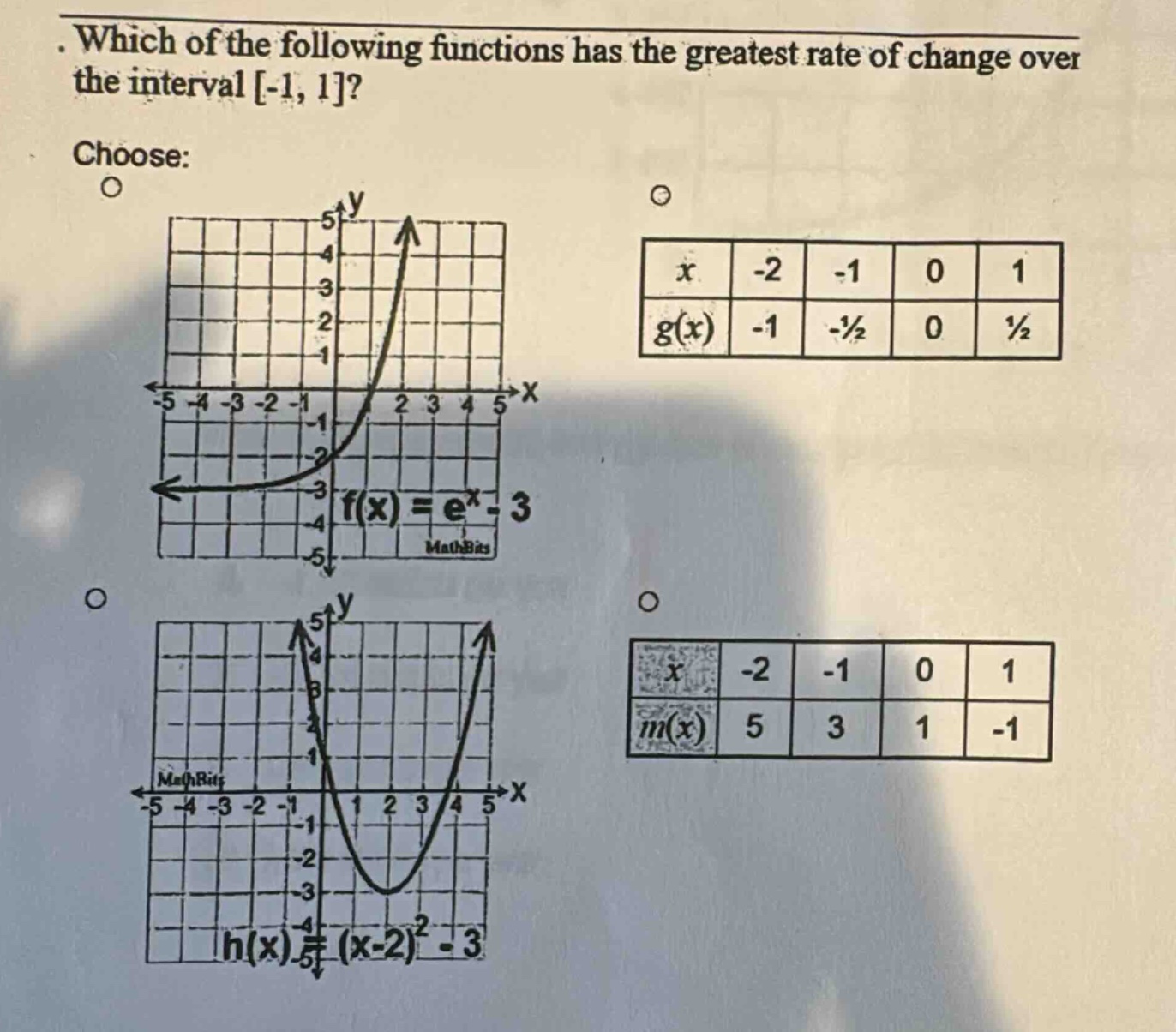
which of the following functions has the greatest rate of change over the interval -1, 1? choose: f(x)=e^x - 3 h(x)=(x - 2)^2 - 3 x -2 -1 0 1 g(x) -1 -1/2 0 1/2 x -2 -1 0 1 m(x) 5 3 1 -1
Answer
Explanation:
Step1: Recall rate - of - change formula
The average rate of change of a function $y = f(x)$ over the interval $[a,b]$ is $\frac{f(b)-f(a)}{b - a}$. Here $a=-1$ and $b = 1$.
Step2: Calculate rate of change for $f(x)=e^{x}-3$
Substitute $x=-1$ and $x = 1$ into $f(x)$: $f(-1)=e^{-1}-3=\frac{1}{e}-3$ and $f(1)=e - 3$. Then the rate of change is $\frac{f(1)-f(-1)}{1-(-1)}=\frac{(e - 3)-(\frac{1}{e}-3)}{2}=\frac{e-\frac{1}{e}}{2}\approx\frac{2.718 - 0.368}{2}=\frac{2.35}{2}=1.175$.
Step3: Calculate rate of change for $g(x)$
From the table, $g(-1)=-\frac{1}{2}$ and $g(1)=\frac{1}{2}$. The rate of change is $\frac{g(1)-g(-1)}{1-(-1)}=\frac{\frac{1}{2}-(-\frac{1}{2})}{2}=\frac{1}{2}=0.5$.
Step4: Calculate rate of change for $h(x)=(x - 2)^{2}-3$
Substitute $x=-1$ and $x = 1$ into $h(x)$: $h(-1)=(-1 - 2)^{2}-3=9 - 3=6$ and $h(1)=(1 - 2)^{2}-3=1 - 3=-2$. Then the rate of change is $\frac{h(1)-h(-1)}{1-(-1)}=\frac{-2 - 6}{2}=-4$.
Step5: Calculate rate of change for $m(x)$
From the table, $m(-1)=3$ and $m(1)=-1$. The rate of change is $\frac{m(1)-m(-1)}{1-(-1)}=\frac{-1 - 3}{2}=-2$.
Answer:
The function $f(x)=e^{x}-3$ has the greatest rate of change over the interval $[-1,1]$.