which of the following functions would not have a horizontal asymptote?\no y = ((x - 2)(x + 1))/((x - 7)(2x…
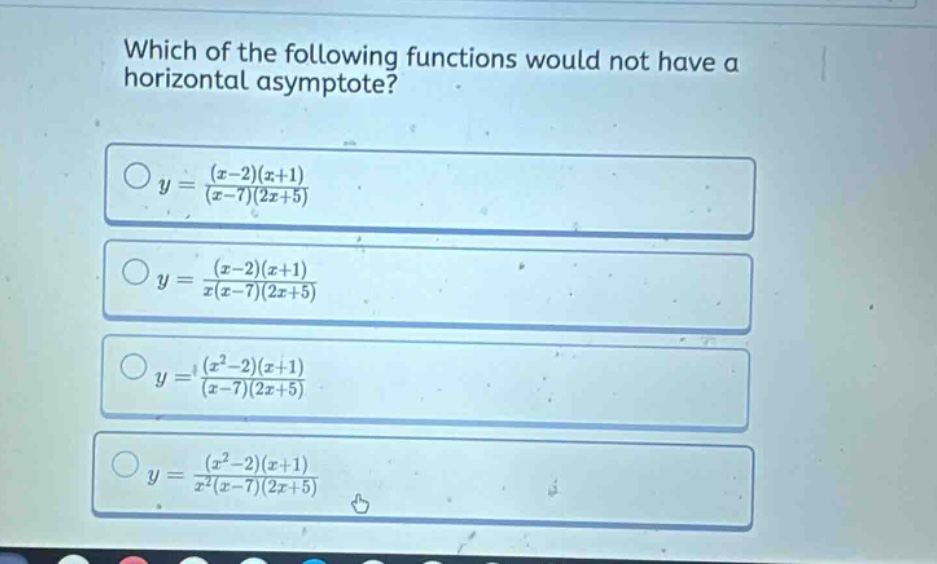
which of the following functions would not have a horizontal asymptote?\no y = ((x - 2)(x + 1))/((x - 7)(2x + 5))\no y = ((x - 2)(x + 1))/(x(x - 7)(2x + 5))\no y = ((x^2 - 2)(x + 1))/((x - 7)(2x + 5))\no y = ((x^2 - 2)(x + 1))/(x^2(x - 7)(2x + 5))
Answer
Answer:
C. $y=\frac{(x^{2}-2)(x + 1)}{(x - 7)(2x+5)}$
Explanation:
Step1: Recall horizontal - asymptote rules
For a rational function $y=\frac{f(x)}{g(x)}$ where $f(x)=a_nx^n+\cdots+a_0$ and $g(x)=b_mx^m+\cdots + b_0$, if $n=m$, $y=\frac{a_n}{b_m}$ is the horizontal asymptote; if $n\lt m$, $y = 0$ is the horizontal asymptote; if $n>m$, there is no horizontal asymptote.
Step2: Analyze Option A
For $y=\frac{(x - 2)(x + 1)}{(x - 7)(2x+5)}=\frac{x^{2}-x - 2}{2x^{2}-9x - 35}$, $n = m=2$, so $y=\frac{1}{2}$ is the horizontal asymptote.
Step3: Analyze Option B
For $y=\frac{(x - 2)(x + 1)}{x(x - 7)(2x+5)}=\frac{x^{2}-x - 2}{2x^{3}-9x^{2}-35x}$, $n = 2,m = 3$, $n\lt m$, so $y = 0$ is the horizontal asymptote.
Step4: Analyze Option C
For $y=\frac{(x^{2}-2)(x + 1)}{(x - 7)(2x+5)}=\frac{x^{3}+x^{2}-2x - 2}{2x^{2}-9x - 35}$, $n = 3,m = 2$, $n>m$, so there is no horizontal asymptote.
Step5: Analyze Option D
For $y=\frac{(x^{2}-2)(x + 1)}{x^{2}(x - 7)(2x+5)}=\frac{x^{3}+x^{2}-2x - 2}{2x^{4}-9x^{3}-35x^{2}}$, $n = 3,m = 4$, $n\lt m$, so $y = 0$ is the horizontal asymptote.