4. which of the following functions will result with a value of -√3/2? a sin(19π/3) b sin(17π/3) c…
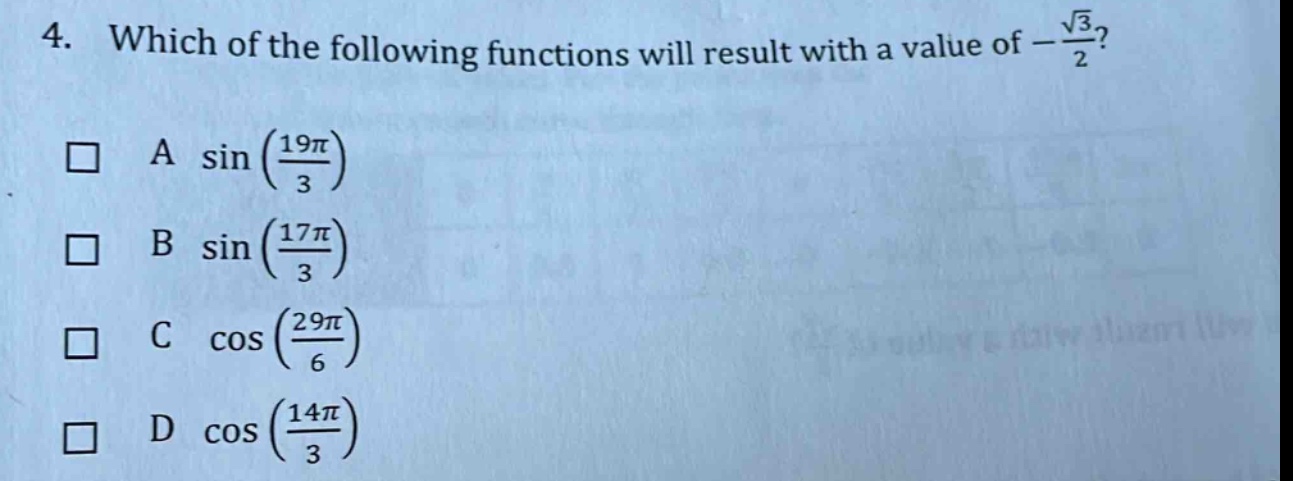
4. which of the following functions will result with a value of -√3/2? a sin(19π/3) b sin(17π/3) c cos(29π/6) d cos(14π/3)
Answer
Explanation:
Step1: Use the periodic - property of trigonometric functions
The period of (y = \sin x) is (2\pi) and the period of (y=\cos x) is (2\pi). For (\sin x), (\sin(x + 2k\pi)=\sin x), (k\in\mathbb{Z}), and for (\cos x), (\cos(x + 2k\pi)=\cos x), (k\in\mathbb{Z}).
Step2: Simplify (\sin(\frac{19\pi}{3}))
(\sin(\frac{19\pi}{3})=\sin(6\pi+\frac{\pi}{3})=\sin\frac{\pi}{3}=\frac{\sqrt{3}}{2}) since (\sin(x + 2k\pi)=\sin x) with (k = 3) and (x=\frac{\pi}{3}).
Step3: Simplify (\sin(\frac{17\pi}{3}))
(\sin(\frac{17\pi}{3})=\sin(6\pi - \frac{\pi}{3})=\sin(-\frac{\pi}{3})=-\sin\frac{\pi}{3}=-\frac{\sqrt{3}}{2}) because (\sin(A - B)=\sin A\cos B-\cos A\sin B) and (\sin(6\pi)=0,\cos(6\pi) = 1), and (\sin(-\alpha)=-\sin\alpha).
Step4: Simplify (\cos(\frac{29\pi}{6}))
(\cos(\frac{29\pi}{6})=\cos(4\pi+\frac{5\pi}{6})=\cos\frac{5\pi}{6}=-\frac{\sqrt{3}}{2}) since (\cos(x + 2k\pi)=\cos x) with (k = 2) and (x=\frac{5\pi}{6}), and (\cos\frac{5\pi}{6}=-\frac{\sqrt{3}}{2}).
Step5: Simplify (\cos(\frac{14\pi}{3}))
(\cos(\frac{14\pi}{3})=\cos(4\pi+\frac{2\pi}{3})=\cos\frac{2\pi}{3}=-\frac{1}{2}) since (\cos(x + 2k\pi)=\cos x) with (k = 2) and (x=\frac{2\pi}{3}), and (\cos\frac{2\pi}{3}=-\frac{1}{2}).
Answer:
B. (\sin(\frac{17\pi}{3})), C. (\cos(\frac{29\pi}{6}))